On this page
On this page
Quick answer: Staff augmentation adds outside engineers to your team, and you manage their daily work. Outsourcing (project outsourcing) hands a whole project to a vendor, and the vendor manages the team and delivers the result. Choose staff augmentation when you have engineering leaders and your scope will change. Choose outsourcing when the scope is fixed and the work is not core to your product. Offshore staff augmentation in Vietnam costs $30-$50 per hour for a senior full-stack engineer, versus $120-$200 in North America (InApps).
Staff Augmentation vs Outsourcing at a Glance
| Factor | Staff augmentation | Outsourcing (project-based) |
|---|---|---|
| What you buy | Engineers’ time | A finished deliverable |
| Who manages daily work | You | The vendor’s PM or tech lead |
| Who owns technical decisions | Your team | The vendor, within your requirements |
| Pricing | Monthly time and materials, per engineer | Fixed price or milestones |
| Scope changes | No change order: reprioritize in the next standup | Change order, often extra cost |
| Time to start | 1-2 weeks | Several weeks: discovery and a signed SOW come first |
| Who carries delivery risk | You | The vendor |
| Where knowledge stays | In your team and repos | Mostly with the vendor until handover |
| Best for | Core product work, skill gaps, capacity surges | Defined, non-core projects |
Typical terms for offshore vendors, Oct 2026. Staff augmentation terms from InApps IT staff augmentation.
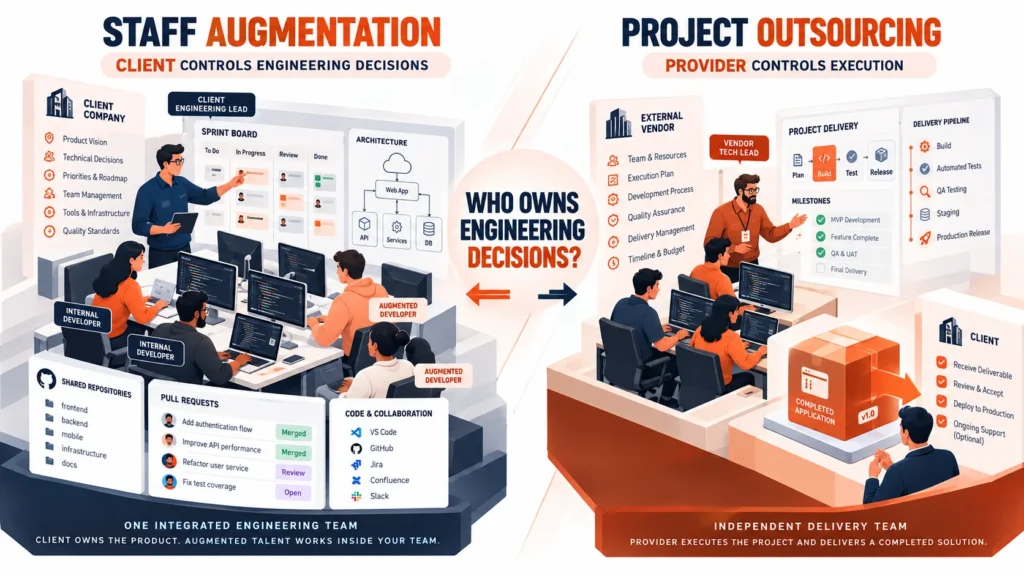
Who manages the work? Switch models to compare
Pick a model to see where the engineers sit, who directs them and who carries the risk.
Your company Runs the work
Augmented engineers join your standups, repos and sprints.
Vendor
Replaces an engineer if the fit is wrong.
- Daily managementYouYou assign tasks and run the sprint.
- Technical decisionsYouYour architecture, your coding standards.
- Delivery riskYouQuality depends on your reviews and QA.
- Scope changesYouReprioritize in the next standup. No change order.
- KnowledgeYouStays in your team and repos.
Fits you if: you have a tech lead with spare time and the work is core product that changes every sprint.
Your company
Your own engineers stay on the core product.
Vendor Runs the work
You rarely talk to individual engineers.
- Daily managementVendorThe vendor’s PM runs the team.
- Technical decisionsVendorWithin the requirements you signed off.
- Delivery riskVendorThe vendor owes you the agreed result.
- Scope changesYou payEach change needs a change order.
- KnowledgeVendorMostly with the vendor until handover.
Fits you if: you can write the full scope today, the project is non-core and you have no one to manage engineers.
What Is the Difference Between Staff Augmentation and Outsourcing?
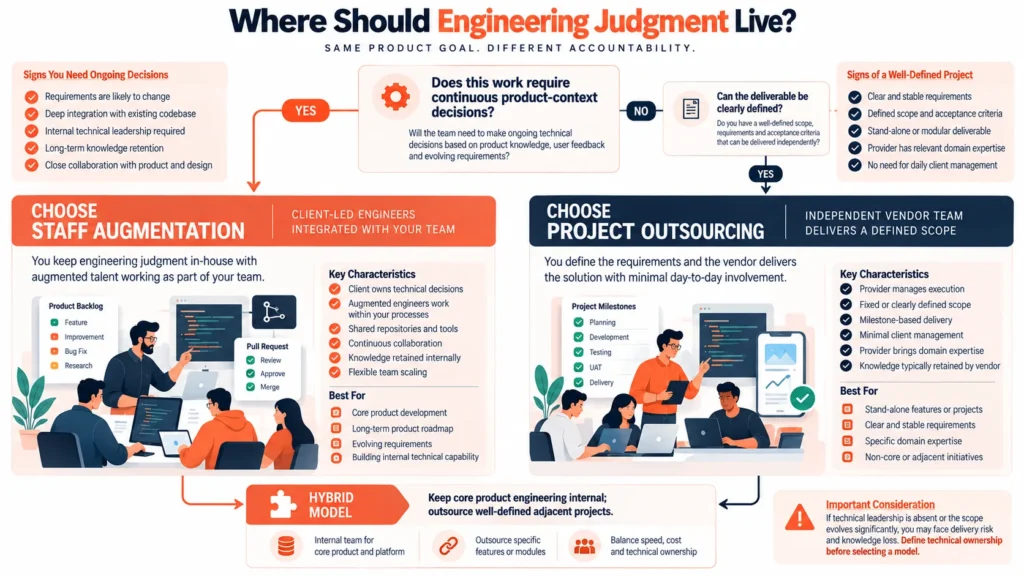
The difference between staff augmentation and outsourcing is who manages the work and who owns the result. In staff augmentation, you direct each engineer. In outsourcing, the vendor directs its own team and owes you a deliverable.
- Staff augmentation extends your team. Augmented engineers join your standups, work in your repos and follow your coding standards. The vendor only handles hiring, payroll and HR.
- Project outsourcing replaces the team for that project. You write the requirements and approve milestones. The vendor decides how to build it and who builds it.
- Software outsourcing and IT outsourcing usually mean the project model. Staff augmentation is technically a form of outsourcing too: you outsource hiring, not delivery.
Deloitte’s 2024 survey of 500+ executives lists third-party staff augmentation and third-party outsourcing as separate sourcing options (Deloitte Global Outsourcing Survey 2024).
There is a middle option. A dedicated team works only for you but brings its own tech lead. Ongoing operations such as support or monitoring fit managed services better.
Staff Augmentation vs Project Outsourcing: Which Costs Less?
Outsourcing usually has the lower starting quote. Staff augmentation usually has the more predictable final bill. Scope change decides the winner: fixed-price contracts charge for every change, while time and materials absorb it.
Scenario: a 6-month mobile app build with 3 developers and 1 QA engineer.
| Cost line (6 months) | Staff augmentation | Outsourcing |
|---|---|---|
| Vendor cost | 4 × $40 × 160 h × 6 = $153,600 | Fixed quote: $150,000 |
| Scope change | $0 (absorbed in sprints) | 20% change orders: $30,000 |
| Your manager’s time | 50% of a US engineer: $34,000 | 10% oversight: $6,800 |
| Total | ≈ $187,600 | ≈ $186,800 |
Assumptions: $40/hour sits inside the $30-$50 Vietnam range (InApps). Manager time is priced at the US software developer median of $135,980/year, or ~$11,332/month (BLS, May 2025). The $150,000 quote and 20% change rate are illustrative inputs. Swap in your own.
Formula:
Staff augmentation total = engineers × rate × hours + (manager cost × % time managing)
Outsourcing total        = fixed quote × (1 + scope change %) + (manager cost × % oversight)
Decision rule: in this scenario the two models break even at about 20% scope change. Expect less change: outsourcing is cheaper. Expect more: staff augmentation is cheaper. For full rate tables, see the IT staff augmentation cost guide.
[For CTOs who need engineers inside their own sprints]: InApps IT staff augmentation
- Why it fits: you interview and pick every engineer, they work in your Jira and GitHub, and you direct all technical decisions.
- Key spec: first engineer in 1-2 weeks, 92% engineer retention at 12 months, free replacement in the first 30 days, IP assigned to you from the first commit, ISO/IEC 27001:2022 certified | Trade-off: you need someone in-house to manage the engineers. If you don’t, a dedicated team or project-based outsourcing fits better.
- Action: See engineer profiles and rates ->
When Should You Choose Staff Augmentation?
Choose staff augmentation when you have engineering leadership in-house and need more hands or a specific skill. It works for product work that changes every sprint.
Pick it when:
- You have a tech lead or engineering manager with time to assign tasks and review code.
- The work is core to your product, so the knowledge must stay inside your team.
- Requirements will change. New priorities cost a standup conversation, not a contract amendment.
- You need a niche skill for 3-6 months, such as a DevOps or AI/ML engineer, without a 6-month hiring cycle.
Trade-off: you carry the delivery risk. Quality depends on your reviews and QA. Read the risks of IT staff augmentation before you add more than 3 people.
When Is Outsourcing the Better Choice?
Choose outsourcing when you can write the full scope before work starts and the project is not what makes your product different. The vendor carries the delivery risk, so you need clear acceptance criteria.
Pick it when:
- The scope is fixed, such as a data migration, an internal tool or a marketing site.
- The function is non-core, such as QA testing or a companion app.
- You have no one to manage engineers, or no one who knows the required stack.
- Finance needs a fixed number before approving the budget.
Trade-off: each change costs money and time, and the code is new to your team at handover. Make sure the contract assigns IP to you and includes documentation and a handover period.
Staff Augmentation or Outsourcing: Decide in 30 Seconds
Two questions settle most cases: can you write the full scope today, and do you have someone to manage engineers? Run this check before you call any vendor.
Can you write the full scope before work starts?
│
├── Yes ──► Is the project core to your product?
│            ├── No ───► OUTSOURCING (fixed price)
│            └── Yes ──► Do you have a tech lead to manage engineers?
│                         ├── Yes ──► STAFF AUGMENTATION
│                         └── No ───► OUTSOURCING, with IP + handover in contract
│
└── No ───► Do you have a tech lead to manage engineers?
             ├── Yes ──► STAFF AUGMENTATION
             └── No ───► DEDICATED TEAM (vendor brings the tech lead)
Need 10+ engineers or your own offshore office? Compare all models in staff augmentation vs dedicated team vs ODC.
Can You Use Staff Augmentation and Outsourcing Together?
Yes, and most large companies already do. The common pattern is staff augmentation for the core product and outsourcing for well-defined side projects.
Deloitte’s 2024 survey shows why the split matters (Deloitte, 2024):
- 70% of executives brought some previously outsourced scope back in-house in the past five years.
- 42% now name access to talent as the top reason to outsource. Cost reduction fell from 70% in 2020 to 34% in 2024.
- 67% are moving to outcome-based outsourcing relationships.
The lesson: companies keep outsourcing for defined deliverables, but pull core work back where they want control. Staff augmentation gives you that control without hiring full-time.
FAQ: Staff Augmentation vs Outsourcing
Is staff augmentation considered outsourcing?
Yes, in a broad sense. You outsource hiring and HR, but you keep control of the work. In project outsourcing, you also hand over management and delivery.
Which is cheaper, staff augmentation or outsourcing?
Outsourcing often quotes lower at the start. Staff augmentation is cheaper when scope changes a lot, because time and materials billing has no change orders. In our 6-month example, the break-even point is about 20% scope change.
Who owns the code in each model?
You do, if the contract says so. Staff augmentation contracts usually assign IP from the first commit. Outsourcing contracts often transfer IP on final payment, so check that clause.
How fast can each model start?
Augmented engineers can start in 1-2 weeks. Outsourced projects need discovery and a signed statement of work first, which usually takes several weeks.
Is offshore IT outsourcing or staff augmentation better for a startup?
Staff augmentation suits most startups, because product requirements change weekly and the knowledge must stay in-house. Outsource only fixed side projects, such as a landing site or an admin panel.
Next step: not sure which model fits your roadmap? Talk to us. We will tell you honestly if outsourcing is the better fit.
Work with us
Need a team that can do this on your codebase?
Tell us what you are shipping and we will send back a scope, a team shape and a fee. No obligation.
Book a free call