On this page
On this page
An offshore development center (ODC) is a dedicated software engineering team in another country that works only for your company. A local partner recruits, employs and houses the engineers and handles payroll, HR and labor law. You set the technical direction and own 100% of the code. Most ODCs start at about 10 engineers and have a working core team in 6-8 weeks. That speed matters when 72% of employers in 41 countries report trouble filling roles (ManpowerGroup, 2026). An ODC suits a long-term product team when you don’t want to open a foreign entity. It is the wrong choice for a one-off project with a fixed scope.
ODC at a Glance
| Question | Short answer |
|---|---|
| Meaning | Your own engineering team abroad. A partner is the legal employer and runs the office and compliance |
| Also called | Offshore development centre (British spelling), dedicated development center, ODC model |
| Typical size | 10+ engineers. A team of 3-8 is a dedicated team, and 1-2 people is staff augmentation |
| Time to start | 6-8 weeks to a working core team |
| Who directs the work | You: roadmap, architecture, code review, priorities |
| Who owns the IP | You. The contract assigns it from day one |
| Pricing | A monthly retainer per engineer plus a one-time setup fee |
| Exit path | Scale down on notice, or move the team to your own entity through build-operate-transfer (BOT) |
| What it is not | Fixed-price outsourcing, a team shared with other clients, or a subsidiary you incorporate yourself |
What Does Offshore Development Center Mean?
An offshore development center is a full-time engineering unit based offshore that works as part of your organization, while a partner company is the legal employer. The term names an engagement model, not a building. The “center” is the team, its workspace and the processes that keep it running.
An ODC has three defining traits:
- Exclusivity. The engineers work only on your product. The partner never moves them to other clients.
- Split responsibility. You direct the engineering work. The partner handles employment contracts, payroll, office space, devices and local law.
- A long horizon. The model is built for multi-year roadmaps. You pay per engineer per month, not per deliverable.
Wikidata lists the offshore development center as its own entity (Q110486877), related to offshore outsourcing. In software, ODC always stands for offshore development center. The same three letters mean unrelated things in other fields, so write the full term at least once in contracts and job posts.
How Does the ODC Model Work?
In the offshore development center model, you decide what gets built and how. The partner makes sure the team stays employed, equipped and compliant. An engagement manager on the partner side handles people issues such as hiring, performance and retention. That manager does not make technical decisions.
| Responsibility | You (client) | ODC partner |
|---|---|---|
| Product roadmap and priorities | Owns | Advises |
| Architecture and coding standards | Owns | Follows |
| Daily tasks and code review | Owns (directly or through your tech lead) | Provides a tech lead if you have none |
| Recruiting and vetting | Approves final interviews | Sources, screens, tests |
| Employment contracts, payroll, benefits | None | Owns |
| Office, devices, network security | Sets the policy | Owns and runs |
| Retention and replacement | Gives feedback | Owns |
| Code and IP | Owns from day one | Assigns by contract |
ODC vs Dedicated Team vs Staff Augmentation vs BOT vs GCC
An ODC sits between renting individual engineers and opening your own foreign subsidiary. You get the control of a captive center without owning the legal entity. Three questions separate the offshore development models: who employs the engineers, who directs them, and how big the team is.
| Model | Legal employer | Who directs the work | Typical size | Pricing | Usual next step |
|---|---|---|---|---|---|
| ODC | Partner | You | 10+ | Retainer per engineer + setup fee | BOT to your own entity |
| Dedicated team | Partner | Shared (partner lead + your product owner) | 3-8 | Retainer per team | Grows into an ODC |
| Staff augmentation | Partner | You | 1-2 (up to about 5) | Hourly or monthly, per person | Dedicated team |
| Build-operate-transfer | Partner, then you | You | 20+ | Operate fee + transfer fee | Captive center |
| GCC / captive center | You (your subsidiary) | You | 50 to 1,000+ | You carry every cost | None |
| Employer of record (EOR) | EOR, on paper only | You (you also recruit and manage) | 1-20 | EOR fee per person | Your own entity |
| Fixed-price outsourcing | Vendor | Vendor | Set by scope | Per deliverable | None |
For a side-by-side of the three most common choices, see ODC vs dedicated team vs staff augmentation.
ODC vs Offshore Delivery Center
An offshore delivery center belongs to the vendor and serves many clients. An offshore development center serves one client only. Large IT services firms use “delivery center” for their own facilities, where engineers move between accounts as projects start and end. To tell which one you are being offered, ask one question: can any engineer on my team ever be moved to another client? If the answer is yes, you are buying a shared delivery team, not an ODC.
What Are the Benefits of an Offshore Development Center?
The main benefits of an offshore development center are faster access to senior engineers, lower total cost, and product knowledge that stays with one stable team. Talent access, not cost, is now the top reason companies outsource, according to Deloitte’s 2024 Global Outsourcing Survey.
| Benefit | What it looks like in practice |
|---|---|
| Talent access | The partner hires from its local market, so you get a core team in 6-8 weeks. At home, three in four employers in the information sector struggle to fill roles, and AI skills are now the hardest to find worldwide (ManpowerGroup, 2026) |
| Lower cost | A senior full-stack engineer costs USD 30-50 per hour in Vietnam, USD 45-75 in Eastern Europe and USD 120-200 in North America (InApps rates table, 2026). An in-house hire also carries employer contributions of 12-30% on top of salary, depending on the country (see the cost section) |
| Full control | Your roadmap, your repositories and your code reviews. Nothing is delivered from a black box |
| Continuity | The same engineers stay on your product for years. At InApps, if an engineer leaves, a replacement arrives within 3-4 weeks at no recruiting cost, with a 2-week handover |
| No foreign entity | No incorporation, local payroll or labor-law exposure. InApps lets you scale up or down on 30 days’ notice |
| Longer working day | A time-zone offset lets work continue after your office closes. Vietnam (GMT+7) shares a full day with Singapore, 4-6 hours with Sydney and 2-4 hours with Europe’s morning (overlap by city) |
Proof point: the ODC InApps runs for Prudential has kept 97% of its engineers and saved the client 65% (InApps client data).
What Are the Risks of an ODC, and How Do You Reduce Them?
Most ODC failures come from weak governance, not from geography. The usual causes are unclear ownership, rushed onboarding and contracts with no exit terms. Every risk below has a matching control, and that control should also be written into the contract.
| Risk | Early warning sign | How to reduce it | Contract clause |
|---|---|---|---|
| Churn and knowledge loss | Key engineers leave during their first year | Shared documentation, paired onboarding, a retention plan run by the partner | Replacement SLA and handover period |
| Black-box delivery | Sprints show green, but the code fails review | Your tech lead reviews every merge. Code stays in your repositories and CI | Repository ownership and access rights |
| Time-zone friction | A simple question waits a full day for an answer | A fixed overlap window, written specs, a shifted schedule when HQ is in the Americas | Defined working hours and overlap |
| IP and data exposure | Shared devices or shared accounts | ISO/IEC 27001 controls, SSO, least-privilege access, an NDA for every engineer | IP assignment from day one. Data terms that meet your home law (EU and UK GDPR, Australia’s Privacy Act 1988, Singapore’s PDPA, California’s CCPA) and the partner country’s law, such as Vietnam’s Personal Data Protection Law 91/2025/QH15 |
| Lock-in and exit cost | No transfer terms in the contract | Agree on BOT and exit terms before you sign | BOT option, transfer fee, non-solicit waiver |
| Hidden management load | Your senior engineers spend hours each week managing the vendor | An engagement manager handles people issues | Roles defined in the SOW |
How to Set Up an Offshore Development Center in 8 Steps
With a partner, setting up an offshore development center takes about 6-8 weeks. Incorporating and staffing your own entity takes months longer. These are the eight steps in order, with the week each one usually happens.
- Define the scope and the role map (week 1). List the roles, seniority, tech stack and success metrics. InApps sends a written role map within 5 days.
- Choose the location (week 1). Compare working-hour overlap with your HQ, talent depth, rates, and whether data can lawfully move between your home country and the partner country. See the best countries to outsource software development.
- Select the partner (weeks 1-2). Confirm that engineers are exclusive to you. Check for ISO/IEC 27001 certification, client references, a replacement policy and a BOT option.
- Sign the contract (week 2). You need an MSA, an SOW or role order, NDAs, an IP assignment and exit or BOT terms.
- Recruit and vet (weeks 2-5). The partner screens candidates and you join the final interviews. InApps runs a 4-stage vetting process, and 3% of candidates pass.
- Prepare the workspace and security (weeks 4-6). Set up devices, the network, SSO accounts and access to your repositories.
- Onboard the team (weeks 5-8). Run domain training and codebase walkthroughs. Give first tickets in pairs with engineers at HQ.
- Run and scale (week 8 onward). Set the sprint cadence, track cycle time, defect rate and retention, and hold a quarterly review. Add or remove roles on notice.
ODC setup timeline: core team running in 6-8 weeks
- Plan
- Build the team
- Launch and run
- 1Scope and role map
- 2Location
- 3Partner selection
- 4Contract
- 5Recruit and vet
- 6Workspace and security
- 7Onboarding
- 8Run and scale
- ⚑Core team running
Assumes a partner that already runs local hiring, payroll and offices. Opening your own entity first adds several months.
Ready to start? InApps can set up a 10-engineer offshore development center in Vietnam in 6-8 weeks. The team works on its own floor in Ho Chi Minh City, the center is ISO/IEC 27001:2022 certified, and you can move to BOT from year two.
How Much Does an Offshore Development Center Cost?
An ODC is usually priced as a monthly retainer per engineer plus a one-time setup fee. Your monthly cost is each engineer’s rate multiplied by their hours, added up across the team, plus any management fee and the setup fee spread over the contract.
| Senior role (USD per hour) | North America | Eastern Europe | Vietnam / Southeast Asia |
|---|---|---|---|
| Full-stack engineer | 120-200 | 45-75 | 30-50 |
| DevOps / cloud engineer | 130-200 | 50-85 | 35-55 |
| AI / ML engineer | 140-220 | 60-95 | 40-65 |
| QA automation engineer | 85-140 | 35-60 | 22-40 |
Source: InApps rates table, 2026 ranges compiled from three published rate surveys. These are benchmarks, not a quote.
Worked example: 10 senior full-stack engineers at 160 hours a month.
- Vietnam: 10 x 160 x USD 30-50 = USD 48,000-80,000 per month
- Eastern Europe: 10 x 160 x USD 45-75 = USD 72,000-120,000 per month
- North America: 10 x 160 x USD 120-200 = USD 192,000-320,000 per month
What an in-house hire really costs at home. A retainer already includes the engineer’s benefits, payroll and office. When you hire at home, you pay employer contributions on top of salary, and then recruiting, equipment and office space on top of that.
| HQ country | Employer cost on top of salary | Source |
|---|---|---|
| United States | About 30% in benefits (insurance, retirement, legally required) | BLS, June 2026 |
| Germany | About 21-22% statutory social insurance (pension, health, unemployment, long-term care) | TK, 2026 rates |
| Singapore | 17% CPF for employees aged 55 and below | CPF Board, 2026 |
| United Kingdom | 15% employer National Insurance above GBP 5,000 a year, plus pension auto-enrolment | GOV.UK, 2026-27 |
| Australia | 12% superannuation guarantee | ATO |
On rates alone, Vietnam comes in about 75% below North America and about 33% below Eastern Europe. The gap in total cost is smaller once you add setup, management, travel and a mix of seniority levels. InApps prices its ODC at 40-70% below US/EU loaded cost.
When Is an ODC the Right Model?
An ODC fits when you need 10 or more engineers for at least 12 months and want to direct them yourself. If the team is smaller or the horizon shorter, another model will cost less and take less effort to run. Use the 12-month mark as a rule of thumb, not a hard limit.
Skip the ODC if the project has a fixed scope and an end date, nobody in-house can own product direction, you need fewer than about 5 engineers, or regulation requires every developer to sit onshore. For 3-8 engineers, a dedicated development team is usually the better fit.
Where Should You Build an Offshore Development Center?
Choose the location by working-hour overlap first, then by talent depth and cost. A cheap team that is never online during your working day ends up costing you in delays.
| Region | Time zone | Best overlap with | Notes |
|---|---|---|---|
| Vietnam | GMT+7 | Australia, Singapore and the rest of APAC, the Middle East, Europe’s morning. The Americas through a shifted schedule | Senior full-stack USD 30-50 per hour |
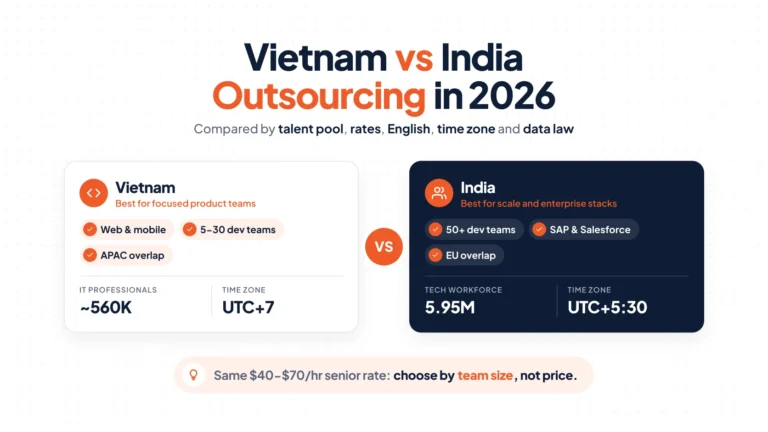
| India | GMT+5:30 | Europe, Middle East | The largest pool: about 2,100 global capability centers (Zinnov-Nasscom, 2026) |
| Eastern Europe | GMT+1 to +3 | UK, Western Europe, the east coast of North America in the morning | Senior full-stack USD 45-75 per hour. Poland and Romania sit inside the EU for GDPR purposes |
| Latin America | GMT-3 to -6 | US, Canada | The nearshore option for North America. Higher rates than Asia |
How Many Hours Overlap With Vietnam?
Vietnam (GMT+7, no daylight saving) shares most of the working day with Asia-Pacific and the Middle East, a few hours with Europe, and none with the Americas unless the team shifts its hours. The figures below assume a 9:00-18:00 day on both sides. Ranges reflect daylight saving at HQ.
| HQ city | Vietnam vs HQ | Overlap in a standard day | How teams cover it |
|---|---|---|---|
| Singapore, Kuala Lumpur, Perth | 1 hour behind | 8 hours | Same working day |
| Sydney, Melbourne | 3-4 hours behind | 4-6 hours | Shared morning stand-up |
| Dubai | 3 hours ahead | 6 hours | Shared afternoon |
| Berlin, Paris, Amsterdam | 5-6 hours ahead | 3-4 hours | Stand-up in Europe’s morning |
| London, Dublin | 6-7 hours ahead | 2-3 hours | Stand-up in Europe’s morning |
| New York, Toronto | 11-12 hours ahead | None | Part of the team starts later to cover your morning |
| San Francisco, Vancouver | 14-15 hours ahead | None | A short early or late call, then async handoffs |
When the team sits within about three hours of HQ, people call it a nearshore development center. The model is the same as an ODC: you trade a higher rate for more overlap. Compare both in nearshore vs offshore software development.
Offshore Development Center FAQ
What is an offshore development center in simple terms?
An offshore development center is your own software team in another country. A local partner hires the engineers, pays them and runs their office. You give the team its work, review its code and own everything it builds.
What is the difference between an ODC and a dedicated team?
The difference is size and setup. A dedicated team is a squad of 3-8 engineers on one product line, often led jointly with the vendor. An ODC has 10 or more engineers in a branded center with its own HR, security and culture, and it usually comes with a build-operate-transfer path.
How many engineers do you need for an offshore development center?
Most ODCs start at about 10 engineers. Below that size, the setup and management overhead outweighs the benefits, and a dedicated team (3-8 engineers) or staff augmentation (1-2 engineers) costs less.
Who owns the code and IP in an ODC?
You do. A standard ODC contract assigns 100% of the intellectual property to the client from day one, and the code lives in the client’s repositories. Check that every engineer has also signed an NDA and an IP assignment.
How long does it take to set up an offshore development center?
With a partner, a core team is usually running in 6-8 weeks: about 2 weeks for requirements and the contract, 3-4 weeks for recruiting, and 2-3 weeks for onboarding. Setting up your own foreign entity first adds several months.
Is an offshore development center the same as outsourcing?
An ODC is a form of offshore outsourcing, but it differs from project outsourcing. In project outsourcing, the vendor controls the team and is paid for deliverables. In an ODC, you control the team and pay per engineer each month.
Can you take an offshore development center in-house later?
Yes, through build-operate-transfer. The partner moves the engineers, equipment and processes to your own legal entity on terms agreed in the original contract. InApps offers BOT from year two.
Work with us
Need a team that can do this on your codebase?
Tell us what you are shipping and we will send back a scope, a team shape and a fee. No obligation.
Book a free call