On this page
On this page
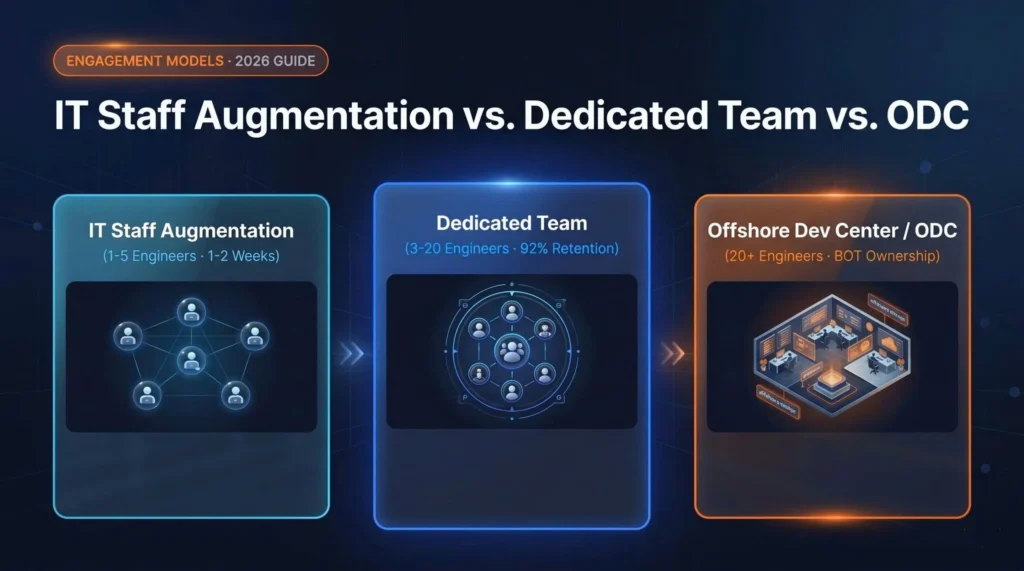
Quick answer: Staff augmentation adds 1-2 engineers to your team, and you manage them. A dedicated team is a 3-20 person squad with its own tech lead that owns delivery for you. An offshore development center (ODC) is your own engineering center abroad: you run the technical work, the vendor runs HR, payroll and the office, and you can take the team in-house later. Rule of thumb: under 6 months, pick staff augmentation. A 6+ month roadmap with no spare managers, pick a dedicated team. 10+ engineers for 12+ months, or a plan to own the team, pick an ODC.
ODC vs Dedicated Team vs Staff Augmentation at a Glance
| Factor | Staff augmentation | Dedicated team | ODC |
|---|---|---|---|
| What you get | Individual engineers inside your team | A self-managed squad: engineers + tech lead + QA | Your own branded center: one or more squads, workspace, processes |
| Who runs daily engineering work | You | The squad’s tech lead | Your engineering leaders |
| Who handles HR, payroll, office | Vendor | Vendor | Vendor |
| Team size | 1-2 engineers (up to 5) | 3-20 engineers | 3 to start, built to grow past 20 |
| Commitment | Weeks to 6 months, 14-day notice | 3-month minimum, 30-day notice | 12+ months |
| Time to start | 1-2 weeks | 4-6 weeks to first sprint | 2-4 weeks to first engineers, 4-6 weeks to full team |
| Upfront cost | None | None | None on a managed floor; setup fee for your own facility or entity |
| Path to own the team | No | No (converts to ODC) | Yes, build-operate-transfer |
| Best for | Skill gaps, release crunches | A product roadmap without spare managers | A long-term R&D hub you control |
Typical terms for Vietnam-based vendors. Source: InApps staff augmentation, dedicated team and ODC service terms, Oct 2026.
Who runs what: ODC vs dedicated team vs staff augmentation
Pick a model to see who manages daily work, who employs the engineers and whether you can own the team later.
You manage daily work. Augmented engineers join your standups, use your tools and take tasks from your engineering manager.
- Team size1-2 engineers (up to 5)
- Time to start1-2 weeks
- CommitmentWeeks to 6 months, 14-day notice
- Own the team later?No
The squad’s tech lead manages daily work. You set priorities and approve sprint goals, and you can talk to any engineer directly.
- Team size3-20 engineers
- Time to start4-6 weeks to first sprint
- Commitment3-month minimum, 30-day notice
- Own the team later?No (converts to ODC)
Your leaders run the center. You own the stack, the rituals and the technical calls. The vendor employs the staff and runs the office.
- Team size3 to start, grows past 20
- Time to start2-4 weeks first engineers, 4-6 weeks full team
- Commitment12+ months
- Own the team later?Yes, via BOT
What Is the Difference Between an ODC, a Dedicated Team and Staff Augmentation?
An ODC, a dedicated team and staff augmentation differ on two points: who runs the daily engineering work, and who can own the team in the long run. Location and hourly rates are often the same, because the same vendor can supply all three.
- Staff augmentation rents you engineers. They join your standups, use your tools and take tasks from your managers.
- A dedicated team rents you a working unit. The squad’s tech lead runs execution, and you set priorities and approve sprint goals.
- An ODC builds you a department. Your CTO runs it like an internal engineering team, while the vendor employs the staff and runs the office.
All three models work only on your product, with 100% IP ownership, if the contract says so. Check that the IP clause assigns code to you on creation, not on final payment.
ODC vs Dedicated Team: What Changes When You Scale?
The ODC model gives you control and an ownership path. The dedicated team model gives you delivery without management work. Both keep engineers dedicated to you, so the choice depends on how much of the team you want to run and keep.
| Question | Dedicated team | ODC |
|---|---|---|
| Who sets the technical direction? | Vendor tech lead, against your roadmap | Your CTO or engineering managers |
| Whose processes and tools? | Mostly the vendor’s | Yours: your stack, your rituals, your security rules |
| Where do engineers sit? | Vendor office, next to other client teams | A dedicated, access-controlled workspace in your name |
| How far does it scale? | One product squad | Several squads plus QA, DevOps and data roles |
| Can you take it in-house? | No | Yes, through build-operate-transfer |
Decision rule: if you only need output on one product, a dedicated team is lighter and faster to run. If you plan to own the team within 2-3 years, or you work in a regulated field such as fintech or insurance, start as an ODC. One example: InApps runs an ODC for Prudential that reached 65% cost savings and 97% engineer retention (InApps ODC).
ODC vs Staff Augmentation: Control vs Commitment
ODC vs staff augmentation is not a control question, because you direct the engineers in both. It is a commitment question. Staff augmentation suits short, flexible needs. An ODC suits a team you want to keep for years.
- Staff augmentation gives you people, not structure. There is no local lead, no shared team culture and no career path, so engineers rotate out more often and knowledge leaves with them.
- An ODC gives you people plus the structure to keep them: local leadership, retention plans, an ISO/IEC 27001:2022 certified workspace and a growth plan for the center.
Decision rule: pick staff augmentation for 1-2 engineers or work under 6 months. Pick an ODC when you need 3+ engineers for 12+ months and have engineering leaders who can run a remote team. For the short-term side of this choice, read our guide to staff augmentation vs outsourcing.
Which Model Costs Less?
Hourly rates are close across all three models, because you pay for the same engineers. What changes is what the rate includes, what you pay upfront, and how much of your managers’ time each model eats. In Vietnam, senior full-stack engineers cost $30-$50 per hour, versus $120-$200 in North America (InApps).
| Cost line | Staff augmentation | Dedicated team | ODC |
|---|---|---|---|
| Pricing basis | Per engineer, monthly time and materials | Per team, monthly retainer | Per engineer per month + management fee |
| Rate includes | The engineer | Engineers + tech lead + QA | Engineers, HR, payroll, office, equipment, security |
| Upfront cost | $0 | $0 | $0 managed floor; setup fee for own facility or entity |
| Hidden cost | Your managers’ time | Minimum term | Your leaders’ time to run the center |
| Exit cost | 14-day notice | 30-day notice | Transfer price under BOT |
Formula: Total monthly cost = vendor invoice + (your manager’s monthly cost × % of time spent managing) + (setup fee ÷ contract months).
Decision rule: staff augmentation has the lowest invoice for 1-2 engineers. A dedicated team usually wins on total cost past 3 engineers, once you price in management time. We model that math line by line in staff augmentation vs dedicated team. An ODC wins past roughly 10 engineers on a 2+ year horizon, where setup costs spread thin and a transfer avoids rehiring.
Which Model Should You Choose? Decide in 60 Seconds
Three questions settle most choices: how many engineers, for how long, and whether you want to own the team later. Run this check before you talk to any vendor.
How long do you need the engineers?
│
├── Under 6 months ──► STAFF AUGMENTATION
│
└── 6+ months ──► How many engineers?
                  │
                  ├── 1-2 ──► STAFF AUGMENTATION
                  │
                  └── 3+ ──► Do you want to own the team in 2-3 years?
                             │
                             ├── Yes ──► ODC (with build-operate-transfer)
                             │
                             └── No ──► Can your leaders run the team daily?
                                        ├── Yes, and 10+ engineers ──► ODC
                                        └── No ──► DEDICATED TEAM
Still unsure about the market itself? See where each model fits by region in offshore vs nearshore software development.
Can You Move from Staff Augmentation to a Dedicated Team to an ODC?
Yes. Most long-term ODCs start small: 1-2 augmented engineers, then a dedicated squad, then a full center. This path lets you test code quality, English and time-zone overlap before you commit to a multi-year setup.
Build-operate-transfer (BOT) is the last step. The vendor builds the center, operates it, then transfers staff, equipment and processes to your own legal entity.
| BOT phase | InApps terms | Industry range |
|---|---|---|
| Build | 4-6 weeks on a managed floor; 4-5 months with your own entity | 4-9 months |
| Operate | Months 2-24 | 2-4 years |
| Transfer | Available from year 2 | 3-6 months; price is a fixed sum or a formula on headcount and assets |
Industry ranges: Outsource Accelerator, Aug 2026. Some providers quote shorter full terms of 18-36 months (Wisemonk, Sep 2026).
Ask any vendor for three things up front: no conversion fee between models, the same engineers carried over, and the transfer price written into the master agreement.
For CTOs who need 10+ engineers and want to own the team later: InApps ODC
- Why it fits: your own dedicated team in Ho Chi Minh City. You talk to engineers directly and run the technical work, while we handle hiring, payroll and the office.
- Key spec: first engineers in 2-4 weeks, full team in 4-6, ISO/IEC 27001:2022 certified, 100% IP assigned on creation, BOT from year 2 | Trade-off: built for 12+ month horizons. For 1-2 engineers, staff augmentation costs less, and we will say so.
- Action: Start your ODC →
FAQ: ODC vs Dedicated Team vs Staff Augmentation
Is an ODC the same as a dedicated team?
No. A dedicated team is a vendor-led squad that works only on your product. An ODC is a center your own leaders run, in a dedicated workspace, with the option to transfer it to your company.
Which model is the cheapest?
Staff augmentation has the lowest invoice for 1-2 engineers. Past 3 engineers, a dedicated team often costs less in total because it removes management work. Past about 10 engineers on a 2+ year plan, an ODC usually gives the lowest cost per engineer.
What is the minimum team size for an ODC?
At InApps, an ODC starts at 3 engineers. For 1-2 engineers, staff augmentation fits better.
Who owns the code in each model?
You do in all three, if the contract assigns IP to you on creation. Check that clause before you sign.
What is build-operate-transfer?
Build-operate-transfer is an ODC option where the vendor builds and runs your center, then moves the staff, equipment and processes to your own entity. At InApps, transfer is available from year 2.
Next step: not sure which model fits your roadmap? Talk to us. We will tell you honestly if staff augmentation is enough.
Work with us
Need a team that can do this on your codebase?
Tell us what you are shipping and we will send back a scope, a team shape and a fee. No obligation.
Book a free call