On this page
On this page
Quick answer: Staff augmentation adds outside engineers to your team. You manage them and you own the result. Managed services hand a whole function, such as app support, cloud operations or IT help desk, to a provider that owns the result under an SLA (service-level agreement). Use staff augmentation to build your product. Use managed services to run stable, repeatable work. Offshore augmented engineers in Vietnam cost $30-$55 per hour, versus $120-$200 in North America (InApps).
Managed Services vs Staff Augmentation at a Glance
| Factor | Staff augmentation | Managed services |
|---|---|---|
| What you buy | Engineers’ time | An outcome: uptime, response times, closed tickets |
| Who manages daily work | You | The provider |
| Who carries the risk | You | The provider, up to the SLA terms |
| Pricing | Monthly time and materials, per engineer | Fixed monthly fee, per user or per device |
| How you measure it | Sprint output, code reviews | SLA metrics and a monthly report |
| Time to start | 1-2 weeks | 4-12 weeks of transition |
| Contract length | Month to month or 3-12 months | Usually 12-36 months |
| Where knowledge stays | In your team and repos | With the provider, unless the contract forces documentation |
| Best for | Product builds, skill gaps, changing priorities | Support, monitoring, patching, 24/7 coverage |
Typical terms for offshore vendors, Oct 2026. Staff augmentation terms from InApps IT staff augmentation. Managed services transition time from InApps Application Managed Services (4-6 weeks) and common IT MSP onboarding.
What Is the Difference Between Staff Augmentation and Managed Services?
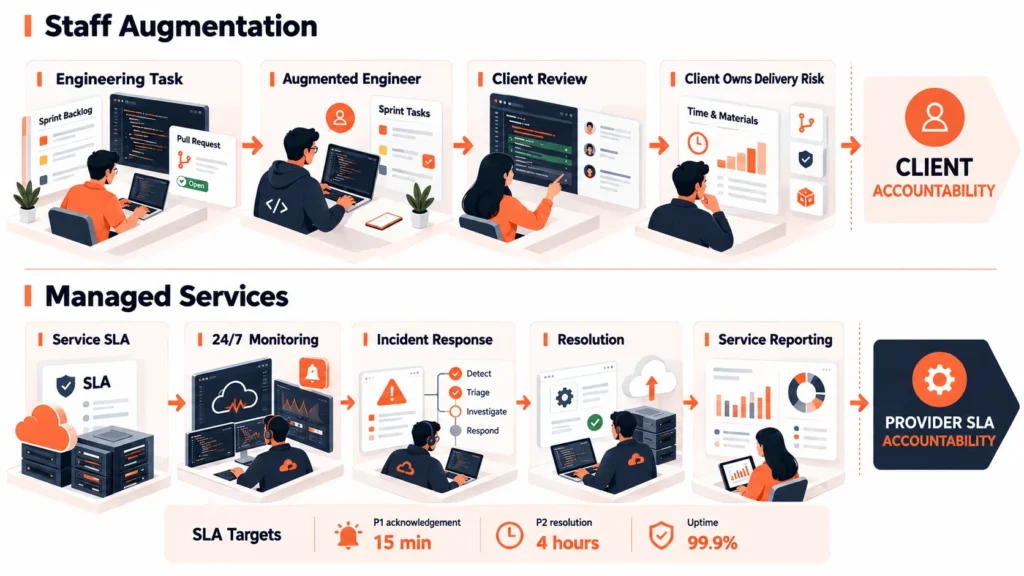
The difference between staff augmentation and managed services is who owns the outcome. With staff augmentation, you direct each engineer and you answer for the result. With managed services, the provider directs its own team and answers to an SLA.
A simple test: it is 4 PM on Friday and production breaks. Who gets paged? If your tech lead does, you need staff augmentation. If the provider’s on-call engineer does, and you only read the incident report, you are buying managed services.
- Staff augmentation extends your team. Engineers join your standups, work in your repos and follow your standards. The vendor handles hiring, payroll and HR only.
- Managed services replace a function. You set the targets, such as 99.9% uptime or a 1-hour response to critical incidents. The provider decides how to hit them.
- IT managed services vs staff augmentation: a classic MSP (managed service provider) runs help desk, devices, networks and security. Application managed services run your live software: monitoring, bug fixes, patching and releases.
Both are forms of outsourcing. For the project-based model, where a vendor builds a defined deliverable and hands it over, see staff augmentation vs outsourcing.
Managed Services Model vs Staff Augmentation: Which Costs Less?
Managed services usually cost less for steady run work, because one provider team covers many hours, including nights. Staff augmentation usually costs less for build work, because new features fall outside a managed services scope and trigger change requests.
Scenario: keep a live SaaS app running for 12 months (monitoring, incidents, patching, small fixes).
| Cost line (12 months) | Staff augmentation | Managed services |
|---|---|---|
| Vendor cost | 1 DevOps at $45 + 1 full-stack at $40, × 160 h × 12 = $163,200 | Fixed fee $12,000 × 12 = $144,000 |
| Transition | $0 | 1 month of overlap: $12,000 |
| Your manager’s time | 15% of a US engineer: $20,400 | 5% for SLA reviews: $6,800 |
| Coverage | Business hours only | Business hours + on-call for critical incidents |
| Total | ≈ $183,600 | ≈ $162,800 |
Assumptions: hourly rates sit inside InApps’ Vietnam ranges of $35-$55 (DevOps) and $30-$50 (full-stack) (InApps). Manager time uses the US software developer median of $135,980 per year (BLS, May 2025). The $12,000 monthly fee is an illustrative input, not a quote. Swap in your own numbers.
Formula:
Staff augmentation total = Σ(engineer rate × hours) + (manager cost × % time managing)
Managed services total   = monthly fee × months + transition cost + (manager cost × % oversight)
                           + change requests for work outside the SLA scope
Decision rule: if most hours go to repeatable tickets and monitoring, managed services win. If your roadmap adds new features every sprint, staff augmentation wins, because the same engineers ship them at no extra contract cost. For IT help desk work, MSPs typically price at $100-$400 per user per month (Datapath, 2026). Full rate tables are in the IT staff augmentation cost guide.
[For CTOs deciding between “build” and “run”]: InApps offers both models
- Why it fits: use IT staff augmentation for engineers inside your sprints, and Application Managed Services for a named team that runs your live app on a fixed monthly fee.
- Key spec: augmented engineers start in 1-2 weeks with a 30-day free replacement; managed services take over in 4-6 weeks, with a named owner per incident and a written monthly report. You own 100% of the IP in both. ISO/IEC 27001:2022 certified | Trade-off: InApps does not run laptops, email or office networks. For that, hire a local IT MSP.
- Action: Talk to us about your build and run split ->
When Should You Choose Staff Augmentation?
Choose staff augmentation when you have engineering leadership in-house and the work changes every sprint. You keep control of code, architecture and priorities.
Pick it when:
- You are building, not maintaining. New features, a new module or a rebuild.
- You have a tech lead with time to assign tasks and review code.
- The knowledge must stay in your team, because the system is core to your product.
- You need a niche skill for 3-6 months, such as an AI/ML or DevOps engineer, without a long hiring cycle.
Trade-off: you carry the delivery risk, and augmented engineers work your hours, not 24/7. Read the risks of IT staff augmentation before you scale past 3 people.
When Are Managed Services the Better Choice?
Choose managed services when the work is stable, measurable and has to run around the clock. You pay for results, not for hours.
Pick it when:
- The work repeats every month: monitoring, patching, backups, Tier 1-3 support.
- You need coverage outside office hours and cannot staff an on-call rotation.
- No one on your team should manage it, because their time belongs on the product.
- Finance wants one fixed monthly number for the function.
Trade-off: scope is fixed, so new work costs extra, and switching providers is slow if the knowledge sits only with them.
What Should a Managed Services SLA Include?
A managed services SLA is only as useful as its definitions. A vague SLA turns managed services into expensive staff augmentation. Check for these six items before you sign:
| SLA item | What “good” looks like |
|---|---|
| Severity levels | Written definitions for critical, high, medium and low |
| Response and fix targets | A time per severity level, for example 1 hour to respond to a critical incident |
| Uptime target | 99.9% allows 8.76 hours of downtime a year. 99.95% allows 4.38 hours |
| Ownership | One named engineer owns each incident until it closes |
| Reporting | A monthly report plus a written root cause for every outage |
| Exit terms | Runbooks, documentation and access handed back within a set notice period |
Uptime math: 8,760 hours per year × (1 – uptime %).
Staff Augmentation or Managed Services: Decide in 30 Seconds
Two questions settle most cases: is the work build or run, and who should get paged when it breaks?
Is the work mostly new features (build) or keeping things running (run)?
│
├── Build ──► Do you have a tech lead to manage engineers?
│              ├── Yes ──► STAFF AUGMENTATION
│              └── No ───► DEDICATED TEAM (vendor brings the tech lead)
│
└── Run ────► Do you need coverage outside business hours?
               ├── Yes ──► MANAGED SERVICES (with a written SLA)
               └── No ───► Is the work stable and measurable?
                            ├── Yes ──► MANAGED SERVICES
                            └── No ───► STAFF AUGMENTATION
No tech lead but a build roadmap? Compare models in staff augmentation vs dedicated team.
Moving from Staff Augmentation to Managed Services (or Using Both)
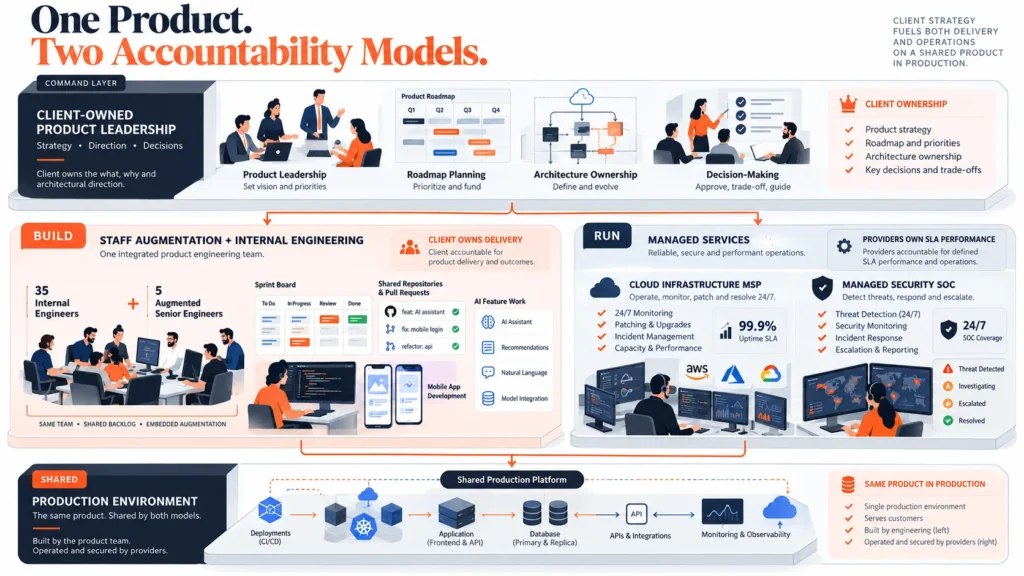
Most companies use staff augmentation and managed services together: augmented engineers build the product, and a managed services provider runs what is already live. The usual path goes from one model to the other as a system matures.
A typical transition from staff augmentation to managed services:
- Build phase: augmented engineers ship the product inside your team.
- Stabilize: they write runbooks, alerts and documentation.
- Co-managed phase: a provider takes on-call and patching, while your team keeps code ownership. This is the co-managed model.
- Managed phase: the provider runs the app under an SLA. Your engineers move to the next build.
Demand for the run side keeps growing. The managed services market is projected to rise from $460.59 billion in 2026 to $705.22 billion by 2031, an 8.9% CAGR, with managed security growing fastest (MarketsandMarkets, June 2026). On the build side, 42% of executives now name access to talent as their top reason to use outside providers (Deloitte Global Outsourcing Survey 2024).
FAQ: Staff Augmentation vs Managed Services
What is the difference between staff augmentation and managed services?
Staff augmentation adds outside engineers to your team. You manage them and you own the result. Managed services hand a whole function, such as app support or cloud operations, to a provider that owns the result under a service-level agreement (SLA).
Is managed services more expensive than staff augmentation?
Not always. For steady run work with after-hours coverage, managed services often cost less, because one provider team covers many shifts. For feature work, staff augmentation costs less, because managed services charge extra for work outside the SLA scope.
What are examples of managed services?
IT help desk, network and device management, cloud operations, managed security (SOC), backups and disaster recovery, and application managed services such as monitoring, bug fixes and patching for live software.
What is managed capacity vs staff augmentation?
Managed capacity, or a managed team, means the vendor supplies a team plus its own lead and is accountable for throughput, not for an SLA. It sits between staff augmentation (you manage) and managed services (provider owns outcomes). A dedicated team works the same way.
Is staff augmentation considered outsourcing?
Yes, in a broad sense. You outsource hiring and HR, but you keep control of the work. With managed services, you also outsource management and accountability.
What is the difference between an MSP and a BPO?
An MSP runs IT functions, such as infrastructure, applications and security. A BPO (business process outsourcing) provider runs business processes, such as customer service, payroll or accounting.
Next step: not sure which work to keep in-house and which to hand off? Talk to us. We will map your build and run split in one call.
Work with us
Need a team that can do this on your codebase?
Tell us what you are shipping and we will send back a scope, a team shape and a fee. No obligation.
Book a free call