On this page
On this page
Quick answer: Nearshore software development puts your team 0-3 hours away, for example Latin America for US companies or Poland for UK companies. You get 6-9 shared working hours at about $53-$66 per hour for a mid-level developer. Offshore puts your team 5-12 hours away, usually in Asia, with 0-4 shared hours at about $27-$65 per hour (HatchWorks, 2026). Choose nearshore when the team must decide things with you live every day. Choose offshore when cost per engineer matters more and the work can run on written specs.
Onshore vs Nearshore vs Offshore at a Glance
| Factor | Onshore | Nearshore | Offshore |
|---|---|---|---|
| Where (for a US buyer) | Same country | Mexico, Colombia, Brazil, Argentina | India, Vietnam, Philippines |
| Where (for a UK/EU buyer) | Same country | Poland, Romania, Portugal, Ukraine | India, Vietnam, Philippines |
| Time difference | 0-3 hours | 0-3 hours | 5-12 hours |
| Shared work hours | 6-9 | 6-9 | 0-4 |
| Mid-level rate (USD/hour) | $120-$150 | $53-$66 | $27-$65 |
| Savings vs onshore | Baseline | About 55% | About 65% |
| Travel for a site visit | Domestic flight | Short-haul, under 6 hours | Long-haul, 15-24 hours |
| Best for | Regulated or on-site work | Agile teams with daily calls | Cost-led builds, async work, follow-the-sun support |
Rates: HatchWorks 2026 mid-level benchmarks. Savings use the midpoint of each range. Shared hours: InApps calculation on a 09:00-18:00 day at both ends, using IANA time zone data.
What Is the Difference Between Nearshore and Offshore?
The difference between nearshore and offshore outsourcing is distance in time zones, not in miles. A nearshore team works within about 3 hours of you. An offshore team works 5 or more hours away, so most of its day happens while you sleep.
- Nearshore: a team in a neighboring region. You hold standups, pair on code and fix blockers the same day.
- Offshore: a team on another continent. Work moves through tickets, specs and recorded demos. You review results the next morning.
- Onshore: a team in your own country. Highest rates, no time-zone or legal friction.
Distance is a choice of location. It says nothing about who manages the team. Both nearshore and offshore vendors sell staff augmentation, dedicated teams and fixed-scope projects. To compare those models, read staff augmentation vs outsourcing.
How Much Does Time Zone Overlap Matter?
Each extra hour of time difference cut real-time communication by 11%, in a study of 12,038 employees at one multinational (Chauvin, Choudhury and Pan Fang, Organization Science, 2024). The same hour removed 19% of shared business hours.
The study found the hit was largest for non-routine work between close collaborators (Rice Business). That is exactly what early product development looks like. Routine work, such as testing against a clear spec or maintenance tickets, suffers much less.
Here is how many hours common city pairs share on a standard 09:00-18:00 day:
| Your office | Team location | Model | Shared hours |
|---|---|---|---|
| New York | Mexico City | Nearshore | 7-8 |
| New York | Bogotá | Nearshore | 8-9 |
| San Francisco | Mexico City | Nearshore | 7-8 |
| London | Kraków | Nearshore | 8 |
| New York | Kraków | Offshore | 3 |
| New York | Bengaluru, Manila or Ho Chi Minh City | Offshore | 0 |
| London | Ho Chi Minh City | Offshore | 2-3 |
| Berlin | Ho Chi Minh City | Offshore | 3-4 |
| Sydney | Ho Chi Minh City | Nearshore | 5-6 |
| Tokyo | Ho Chi Minh City | Nearshore | 7 |
| Singapore | Ho Chi Minh City | Nearshore | 8 |
Ranges cover daylight saving time on and off. Mexico, Colombia and Vietnam do not change clocks.
Decision rule: keep at least 2 shared hours for any team that ships product features. Below that, a blocked engineer waits a full day for an answer.

Is Nearshore Cheaper Than Offshore?
No. Offshore is cheaper per hour. Nearshore costs about 30% more for the same seniority, and the gap shrinks once you add the cost of slower decisions.
| Region (2026) | Agency rate per hour | Model for a US buyer |
|---|---|---|
| United States | $150-$300 | Onshore |
| Latin America | $40-$100 | Nearshore |
| India | $25-$75 | Offshore |
| Southeast Asia | $25-$65 | Offshore |
Source: RaftLabs agency bands, cited in FullStack, Oct 2026. Senior full-stack engineers in Vietnam bill $30-$50 per hour versus $45-$75 in Eastern Europe (InApps benchmarks).
Cost Comparison: Nearshore vs Offshore Development for 12 Months
Scenario: 5 mid-level engineers for 12 months (1,920 hours each), managed by your US engineering lead.
| Cost line | Nearshore (Latin America) | Offshore (Vietnam) |
|---|---|---|
| Team | 5 × $60 × 1,920 = $576,000 | 5 × $40 × 1,920 = $384,000 |
| Your lead’s time | 15% of a US engineer = $20,400 | 25% (async handoffs) = $34,000 |
| Travel | 2 trips × $3,000 = $6,000 | 2 trips × $6,000 = $12,000 |
| Total | $602,400 | $430,000 |
Assumptions: $60 and $40 sit inside the HatchWorks mid-level ranges above. Lead time uses the US software developer median of $135,980 a year (BLS, May 2025). Travel costs are illustrative. Swap in your own numbers.
Break-even formula:
Break-even delay (months) = (Nearshore total - Offshore total) / Offshore monthly cost
                          = ($602,400 - $430,000) / ($430,000 / 12)
                          ≈ 4.8 months
In this scenario, offshore stays cheaper unless time-zone friction delays the year’s work by close to 5 months. Few teams lose that much. The real question is speed to market: if a launch date is worth more than $172,400 to you, nearshore can still win. Full rate tables by role are in the IT staff augmentation cost guide.
[For teams that want offshore rates without losing the workday]: InApps dedicated teams in Vietnam
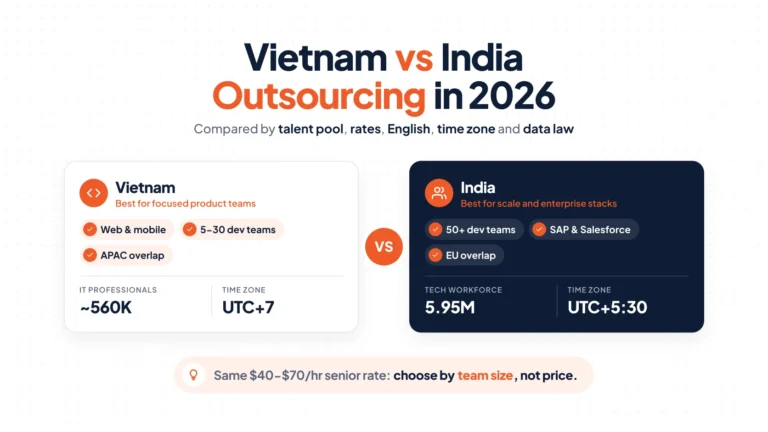
- Why it fits: Vietnam (UTC+7) is offshore for the US and Europe but nearshore for Australia, Japan and Singapore. Shifted schedules give UK clients 4-5 shared hours and US clients 1-2.
- Key spec: senior full-stack $30-$50 per hour, first engineer in 1-2 weeks, 30-day free replacement, ISO/IEC 27001:2022 certified | Trade-off: a New York team still gets only 1-2 shared hours. If you need 6 or more, a Latin American vendor fits better.
- Action: See how a dedicated team works ->
When Should You Choose Nearshore?
Choose nearshore when your product changes every week and decisions cannot wait until tomorrow.
- You run Scrum with daily standups and want the whole team in them.
- You have no tech lead who can write detailed specs for an overnight team.
- The project is short, under 3 months, so there is no time to build async habits.
- Your team must visit often, for workshops or on-site client work.
Trade-off: you pay about 30% more per hour, and Latin American and Eastern European talent pools are smaller than India’s or Southeast Asia’s for niche stacks.
When Should You Choose Offshore?
Choose offshore when budget per engineer drives the decision and the work can be specified in writing.
- You are scaling a team past 5 engineers, where a $20 per hour gap adds up to $192,000 a year.
- The scope is clear: a defined build, QA, migration or maintenance.
- You want work moving while you sleep: overnight testing, follow-the-sun support.
- You have a tech lead who can own specs, reviews and a 1-2 hour daily overlap.
Trade-off: blocked engineers can lose a day per question. Read the risks of IT staff augmentation before scaling an offshore team.
Nearshore or Offshore: Decide in 30 Seconds
Two questions settle most cases: how many shared hours do you need, and can you write specs that survive a night?
Does the work need live decisions with you every day?
│
├── Yes ──► Is there a lower-cost hub with 4+ shared hours in your region?
│            │          (e.g. Vietnam for Australia, Japan, Singapore)
│            ├── Yes ──► THAT HUB (nearshore for you, at offshore rates)
│            └── No ───► NEARSHORE
│
└── No ───► Do you have a tech lead to own specs and reviews?
             ├── Yes ──► OFFSHORE (keep a 1-2 hour daily overlap)
             └── No ───► OFFSHORE DEDICATED TEAM (vendor supplies the lead)
Is Vietnam Nearshore or Offshore?
Vietnam is offshore to New York and London, but nearshore to Sydney, Tokyo and Singapore. “Nearshore” depends on where the buyer sits, not on the vendor’s country.
- US clients: 11-12 hours apart. Standard hours give 0 overlap. A shifted 13:00-22:00 Vietnam schedule gives 1-2 hours with New York mornings.
- UK and EU clients: 5-7 hours apart. Expect 2-4 shared hours, or 4-5 with London on a shifted 11:00-20:00 Vietnam schedule.
- Australian, Japanese and Singaporean clients: 1-4 hours apart. That is 5-8 shared hours, the same as a nearshore team.

Can You Use Nearshore and Offshore Together?
Yes. Many companies run a nearshore and offshore mix: a small nearshore group handles daily product decisions, and a larger offshore team builds, tests and maintains. This is often called rightshoring.
A common split:
- Nearshore or onshore: product owner, tech lead, 1-2 senior engineers.
- Offshore: feature development, QA automation, maintenance.
- The handoff: the nearshore lead writes specs before the offshore day starts and reviews pull requests the next morning.

Access to talent, not only cost, now drives these choices. 42% of executives name access to talent as their top reason to use outside providers (Deloitte Global Outsourcing Survey 2024). To run the offshore side as your own branch, see how an offshore development center works.
FAQ: Nearshore vs Offshore
What is the difference between nearshore and offshore?
Nearshore teams work in a nearby country within about 3 hours of your time zone, so you share 6-9 working hours. Offshore teams work 5-12 hours away, usually in Asia, so you share 0-4 hours but pay less per hour.
Is nearshore cheaper than offshore?
No. Offshore rates are lower. A mid-level developer costs about $53-$66 per hour nearshore and $27-$65 per hour offshore in 2026. Nearshore can still cost less in total when time-zone delays would slow a time-critical launch.
What is onshore vs nearshore vs offshore?
Onshore means a team in your own country. Nearshore means a team in a nearby country with a similar time zone. Offshore means a team on another continent with a large time difference. Rates fall, and coordination effort rises, in that order.
Is Mexico nearshore and the Philippines offshore?
For US companies, yes. Mexico City is 1-2 hours from New York and shares 7-8 working hours. Manila is 12-13 hours away and shares none on a standard day.
Is Eastern Europe nearshore or offshore?
Eastern Europe is nearshore for UK and Western European companies, with a 0-2 hour difference. For US companies it is offshore: Kraków is 6 hours ahead of New York and shares about 3 working hours.
What is nearshore vs offshore staffing?
It is the same location choice applied to staff augmentation. You add individual engineers to your team, either from a nearby country (nearshore) or a distant one (offshore), and you manage them yourself.
What is rightshoring?
Rightshoring means placing each type of work in the location that fits it best: decision-heavy roles onshore or nearshore, build and support work offshore. It is a mix of nearshore and offshore, not a third location.
Next step: not sure how many shared hours your team needs? Talk to us. We will map your roles to nearshore, offshore or a mix in one call.
Work with us
Need a team that can do this on your codebase?
Tell us what you are shipping and we will send back a scope, a team shape and a fee. No obligation.
Book a free call