

On this page
On this page
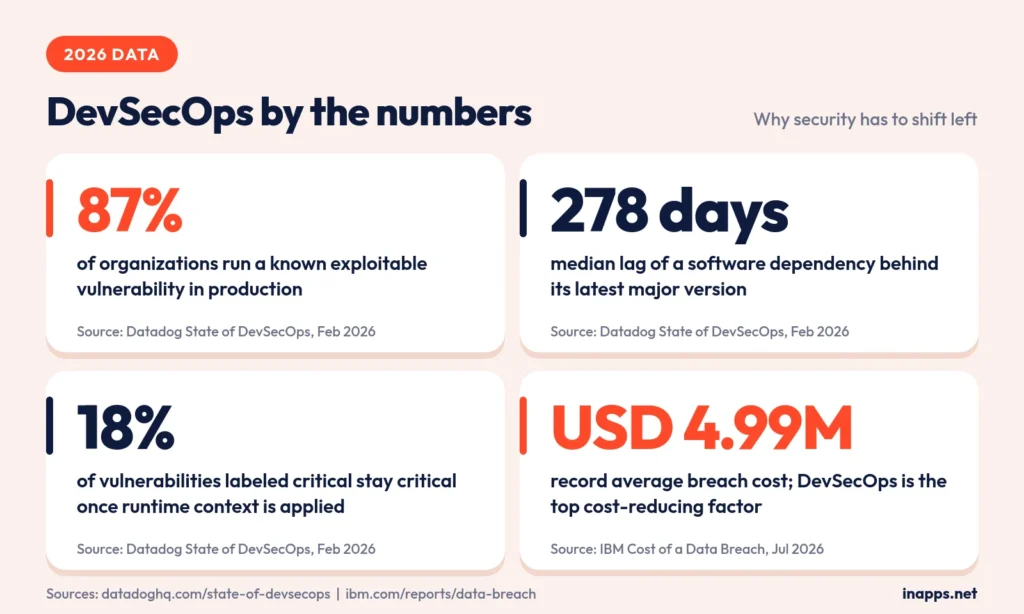
DevSecOps (development, security and operations) is the practice of running automated security checks at every stage of the DevOps pipeline, from design to production, so the engineers who write and ship code also fix its security flaws. It replaces the single security review before release. Why it matters: Datadog (February 2026) found 87% of organizations run a known exploitable vulnerability in production, and IBM’s 2026 breach study names DevSecOps the top factor that lowers breach costs, which now average USD 4.99 million.
DevSecOps in 30 Seconds
| Question | Answer |
|---|---|
| Stands for | Development, security, operations. Also called SecDevOps |
| Core idea | Shift left: find flaws in design and code, where fixes are cheapest |
| How it works | A security check and a pass/fail gate in each pipeline stage |
| Who owns it | Everyone: developers fix, security sets policy, operations monitors |
| First step | Secrets and dependency scanning in CI: free tools, under a week |
What Does DevSecOps Mean?
DevSecOps means security is a built-in part of software delivery, not a gate at the end of it. Every commit, build and deployment runs automated security tests, and failures go back to the team that caused them.
DevOps made releases fast by joining development and operations. Security stayed outside as a manual review and became the bottleneck. DevSecOps puts it inside the same automated pipeline. Red Hat frames it as a shared responsibility across the whole IT lifecycle. SecDevOps is the same practice under another name.
DevSecOps vs DevOps: What Is the Difference?
DevOps optimizes for delivery speed; DevSecOps keeps that speed and proves each release is safe to ship. The tools overlap. What changes is when security runs and who fixes findings.
| DevOps | DevSecOps | |
|---|---|---|
| Security testing | Manual, near release | Automated, on every commit |
| Flaws found | Late, in staging or production | Early, where they were introduced |
| Who fixes them | Security or operations team | The developer who wrote the code |
| Compliance | Periodic audits | Continuous, evidence from the pipeline |
Done well, DevSecOps does not slow releases. Gate only on exploitable findings: Datadog found just 18% of “critical” vulnerabilities stay critical once runtime context is applied. Track the DORA metrics to confirm flow holds.
How Does DevSecOps Work?
A DevSecOps pipeline adds a security check and a release gate to each of five stages: plan, code, build, test and production. Most checks sit in the first three stages, where a fix takes minutes instead of an incident.

| Stage | Security check | Free tools | Block the release if… |
|---|---|---|---|
| 1. Plan | Threat modeling | OWASP Threat Dragon | A feature has no logged threats |
| 2. Code | SAST, secrets scanning | Semgrep CE, Gitleaks | A live secret or high-severity flaw is found |
| 3. Build | Dependency (SCA) and container scanning, SBOM | Trivy, OSV-Scanner, Syft | A critical CVE with a fix is present |
| 4. Test | DAST, infrastructure-as-code scanning | ZAP, Checkov | A critical finding is open in staging |
| 5. Production | Cloud posture, runtime detection | Prowler, Falco | Never block: alert and fix within SLA |
Which DevSecOps Tools Should You Start With?
Start with the free tools in the table; buy a platform when triaging results across separate scanners becomes the bottleneck. Commercial suites (Snyk, Checkmarx, GitHub Advanced Security, Wiz, Prisma Cloud) mainly add one dashboard, deduplication and support. The 2026 trend is consolidation: Google closed its Wiz purchase on March 11, 2026 (Google Cloud). Running containers? See the Kubernetes vs Docker guide for which layer each scanner protects.
Why Is DevSecOps Important?
DevSecOps matters because most production software already ships with exploitable flaws, and late fixes cost the most. Four 2026 data points make the case:
- 87% of organizations run at least one known exploitable vulnerability in deployed services (Datadog).
- 278 days: how far the median dependency lags its latest version; 42% of services use unmaintained libraries (Datadog).
- USD 4.99 million: record average breach cost, with a DevSecOps approach the top cost-reducing factor (IBM via Help Net Security).
- Supply chain risk: the OWASP Top 10:2025 added A03 Software Supply Chain Failures.
Compliance is the second reason. Pipeline logs, SBOMs and fix tickets double as audit evidence for NIST SSDF, PCI DSS v4.0.1, ISO/IEC 27001 and SOC 2. Since September 11, 2026, the EU Cyber Resilience Act also requires manufacturers to report actively exploited vulnerabilities within 24 hours.
DevSecOps Principles and Best Practices
Six principles separate a working DevSecOps program from a pile of unread scanner reports.
| Principle | Best practice | Common mistake |
|---|---|---|
| Shift left | Threat model in design; scan in the IDE and on pull requests | First scan runs in staging |
| Automate | Every check runs in CI; rules live in version control | Security steps that rely on memory |
| Prioritize by risk | Block exploitable, fixable findings; report the rest | Blocking every medium alert until devs bypass gates |
| Least privilege | Per-service roles, short-lived credentials | Shared admin keys in CI variables |
| Secure the supply chain | Pin dependencies and CI actions; SBOM per release | Floating tags like @master or :latest |
| Measure outcomes | Track mean time to remediate per team | Counting scans as success |
Shipping LLM features? AI-generated code needs the same gates, plus the controls in the AI agent security best practices guide.
How to Implement DevSecOps in 90 Days
Switch on the controls that remove the most risk per hour of setup first: secrets and dependencies in week one, runtime last. Run each new check in report-only mode for a week before it can block a build.
| When | Switch on | Done when |
|---|---|---|
| Week 1 | Secrets scanning with push protection; dependency scanning in CI | Every repository is scanned on every push |
| Days 8 to 30 | SAST on pull requests; container scanning; SBOM; CI actions pinned to commit SHAs | Findings show in pull requests |
| Days 31 to 60 | IaC scanning; DAST in staging; policy-as-code | Staging deploys pass gates without overrides |
| Days 61 to 90 | Cloud posture and runtime alerts; fix SLAs; one security champion per squad | Mean time to remediate is tracked |
For fix SLAs, many teams copy CISA’s BOD 19-02: critical vulnerabilities within 15 days, high within 30. Production alerts are only as good as your telemetry; see observability vs monitoring.
Who Does DevSecOps? Roles, Skills and Pay
DevSecOps is a shared job with three clear roles, and it is a branch of cybersecurity focused on software delivery.
- Developers fix findings in their own code.
- Security champions, one developer per squad, triage findings and lead threat modeling.
- DevSecOps engineers build the scanners and gates, write policy-as-code, cut false positives and automate audit evidence.
Is DevSecOps hard to learn? Easier from DevOps or AppSec than from zero. You need CI/CD, containers and one cloud first; the new layer is threat modeling, scanner tuning and policy-as-code. Pay: UK permanent DevSecOps engineer ads show a £62,000 median for the six months to November 9, 2026 (ITJobsWatch, 24 salaries). Senior DevOps and cloud contractors cost USD 130-200 per hour in North America versus USD 35-55 in Vietnam (InApps rate benchmark).
How InApps Builds DevSecOps Into Your Pipeline
InApps adds these five security stages to every software product development and DevOps consulting engagement from the first sprint, using tools that fit your cloud and existing licenses. Inheriting a codebase? The InApps code audit service runs SAST, dependency and IaC scans and returns a ranked fix backlog.
Book a DevSecOps pipeline review to see which of the five stages your pipeline is missing.
Frequently Asked Questions
What is DevSecOps?
DevSecOps (development, security and operations) is the practice of running automated security checks at every stage of the DevOps pipeline, from threat modeling in design to runtime monitoring in production, with developers, security and operations sharing responsibility for fixes.
What is the difference between DevOps and DevSecOps?
DevOps automates software delivery and usually leaves security to a manual review near release. DevSecOps runs security checks on every change and makes developers fix what they find. The tools overlap; the timing and ownership of security differ.
What does shift left mean in DevSecOps?
Shift left means moving security checks earlier, from pre-release testing into design and coding, where a flaw takes minutes to fix instead of an incident response.
What are the main DevSecOps tools?
Common free choices are Semgrep (SAST), Gitleaks (secrets), Trivy and OSV-Scanner (dependencies and containers), Checkov (infrastructure as code), ZAP (DAST), Prowler (cloud posture) and Falco (runtime). Snyk, Checkmarx, GitHub Advanced Security and Wiz are popular paid platforms.
How do you start implementing DevSecOps?
Turn on secrets scanning and dependency scanning in CI this week with free tools. Add SAST and container scanning next, then IaC scanning and DAST, then runtime monitoring. A full pipeline takes about 90 days.
Is DevSecOps part of cybersecurity?
Yes. DevSecOps is application security built into the software delivery process: it prevents flaws in code, dependencies, containers and cloud configuration and detects attacks after release.
What is the difference between DevSecOps and SecDevOps?
There is no formal difference. Both mean building security into DevOps; some teams say SecDevOps to stress that security requirements come first.
What does a DevSecOps engineer do?
A DevSecOps engineer builds and runs security automation in the CI/CD pipeline: scanners, release gates, policy-as-code, secrets management and automated audit evidence for frameworks such as SOC 2 or ISO 27001.
Is DevSecOps hard to learn?
It is manageable if you already know CI/CD, containers and one cloud platform. The extra skills are threat modeling, tuning security scanners and writing policy-as-code; most DevSecOps engineers move in from DevOps or application security.
How much does a DevSecOps engineer earn?
Pay varies by country and seniority. In the UK, permanent DevSecOps engineer job ads showed a median of £62,000 for the six months to November 9, 2026, according to ITJobsWatch.
Work with us
Need a team that can do this on your codebase?
Tell us what you are shipping and we will send back a scope, a team shape and a fee. No obligation.
Book a free call


