On this page
On this page
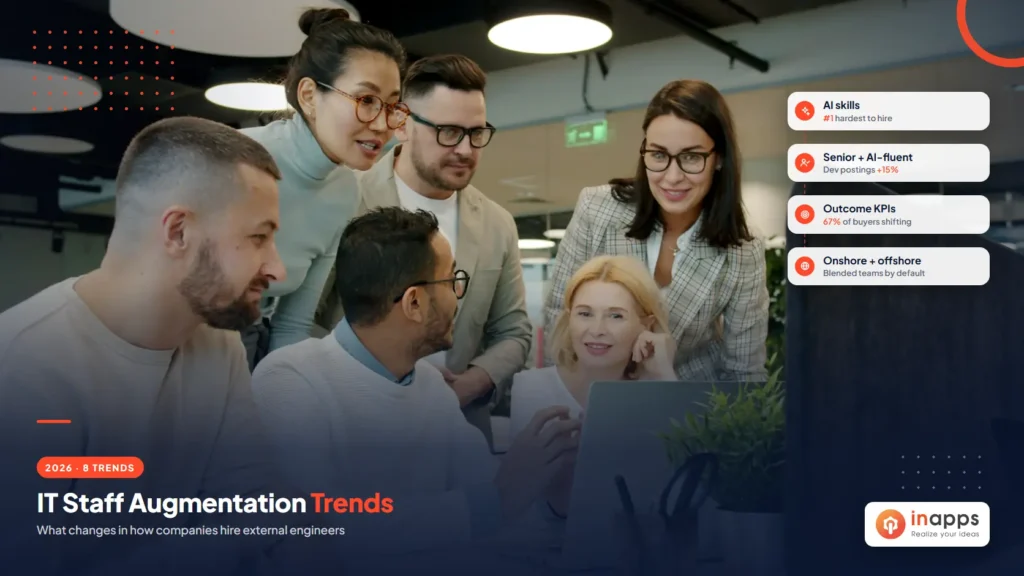
Quick answer: The top IT staff augmentation trends in 2026 are: (1) AI skills are now the hardest talent to find, (2) demand has moved to senior, AI-fluent engineers, (3) companies augment for talent access more than cost, (4) contracts add outcome KPIs, (5) hybrid human + AI agent teams appear, (6) blended onshore-offshore teams become the default, (7) security and AI compliance vetting is required, and (8) skills-based matching cuts ramp-up to 1-2 weeks. Demand is recovering slowly: US IT staffing revenue is forecast to grow 1% to $37.7B in 2026, its first gain since 2022 (SIA, March 2026).
8 IT Staff Augmentation Trends at a Glance
| # | Trend | Evidence (2024-2026) | What to do |
|---|---|---|---|
| 1 | AI skills top the shortage list | AI ranks #1 hardest skill to find for the first time; 72% of employers struggle to hire (ManpowerGroup 2026) | Augment AI/ML roles instead of waiting months for full-time hires |
| 2 | Senior, AI-fluent engineers win | Software development postings up ~15% since early 2025, driven by senior AI hiring; all postings down 7% (Indeed via CIO Dive) | Pay for seniority; test AI tool skills in interviews |
| 3 | Talent access beats cost | 42% name talent access as the top outsourcing driver; cost fell from 70% to 34% (Deloitte 2024) | Choose vendors by skill depth, not lowest rate |
| 4 | Outcome KPIs in contracts | 67% are moving to outcome-based relationships (Deloitte 2024) | Add delivery KPIs to time-and-materials terms |
| 5 | Human + AI agent teams | 10% of IT staffing firms above $50M revenue already place hybrid teams; 40% experiment (SIA study via KORE1) | Ask vendors how engineers use AI agents on your code |
| 6 | Blended onshore-offshore | SIA lists offshoring among the reasons US IT staffing shrank in 2023-2025 | Keep leads near you, scale execution offshore |
| 7 | Compliance vetting | EU AI Act duties for hiring AI apply from Dec 2, 2027 (Gibson Dunn) | Require ISO/IEC 27001 or SOC 2, an AI tool policy and IP clauses |
| 8 | Skills-based matching | Buyers specify skills and outcomes, not titles; vetted engineers start in 1-2 weeks (InApps) | Write a skills brief before you contact vendors |
Is the IT Staff Augmentation Market Growing in 2026?
Yes, but slowly in headcount and quickly in AI-related spend. US IT staffing revenue should reach $37.7B in 2026, up 1% after three years of decline, while worldwide IT spending grows 14.2% to $6.37 trillion, led by AI.
- Staffing revenue: SIA forecasts US IT staffing at $37.7B (+1%) for 2026 (SIA, March 2026). Total US staffing grows 2.4% to $183.1B (SIA, September 2026).
- IT budgets: Gartner expects $6.37T in IT spending (+14.2%). IT services grow a modest 5.3%, while growth “is increasingly concentrated” in AI segments (Gartner, July 2026).
- Labor market: US tech unemployment fell to 2.8% in July 2026, its third monthly drop (CompTIA via CIO Dive).
Why market-size reports disagree. Global “IT staff augmentation market” estimates for 2026 range from $1.09B to $434.1B (KORE1 compilation). Narrow reports count only staff augmentation services. Wide reports add managed services and offshore development centers. For budgeting, use SIA (staffing revenue) and Gartner (IT spend), which publish their methods.
Takeaway: the money is there, but it goes to specific skills, not generic headcount.
The 8 IT Staff Augmentation Trends Explained
1. AI Skills Are Now the Hardest IT Talent to Find
AI skills ranked as the hardest skill to hire for the first time in 2026. ManpowerGroup’s survey of 39,000 employers in 41 countries puts AI model and application development at 20% and AI literacy at 19%. Traditional IT and data skills fell to seventh place (17%) (ManpowerGroup).
IDC predicted that over 90% of organizations would feel the IT skills shortage by 2026, costing $5.5 trillion in delays and lost revenue (IDC).
Decision rule: if an AI role has been open for more than 60 days, augment it. See how to hire AI engineers or the AI staff augmentation model.
2. Demand Shifts From Junior Coders to Senior, AI-Fluent Engineers
Senior engineers who can review AI output are the most requested augmented profile. Software development postings rose nearly 15% since early 2025, “driven mainly by senior, AI-focused hiring,” while overall postings fell 7% (CIO Dive).
The reason is code review. 84% of developers use or plan to use AI tools, but 46% distrust their accuracy and only 33% trust it (Stack Overflow 2025). Someone must own what AI writes. AI fluency also counts in hiring: 71% of leaders would pick a less experienced candidate with AI skills over a more experienced one without them (Microsoft Work Trend Index 2024).
Rule of thumb: keep at least one senior reviewer for every 3-4 augmented engineers.
3. Companies Augment for Talent Access, Not Just Lower Rates
Access to talent is now the top reason to use external engineers, not cost. In Deloitte’s 2024 survey, 42% named talent access as the top driver. Cost reduction dropped from 70% in 2020 to 34% in 2024. 70% also brought some outsourced scope back in-house (Deloitte).
Staff augmentation fits this shift: you get the skills, and the work and knowledge stay with your team. Compare the models in staff augmentation vs outsourcing.
4. Time-and-Materials Contracts Now Carry Outcome KPIs
Buyers keep hourly or monthly billing but attach measurable delivery KPIs. Deloitte found 67% of companies moving to outcome-based relationships. In staff augmentation you manage the daily work, so pure outcome pricing is rare. The practical version is time and materials plus four KPIs:
- Replacement SLA (for example, a new engineer within 10 business days).
- Ramp-up time to the first merged pull request.
- Defect or rework rate per sprint.
- 12-month engineer retention.
If you want the vendor to own the outcome itself, a dedicated team or managed services fits better.
5. Hybrid Human + AI Agent Teams Move From Pilot to Practice
Staffing firms have started placing engineers who work alongside AI agents. In an SIA study of 41 IT staffing executives, 10% of firms above $50M revenue already place hybrid human-plus-AI-agent teams and 40% are experimenting. Among smaller firms, 5% are piloting (KORE1).
The effect: fewer people per project, but each one must direct agents and review their output. Ask every vendor three questions: which AI tools do your engineers use, under whose license, and does any of our code or data leave our environment?
6. Blended Onshore and Offshore Teams Become the Default
Most augmented teams now mix a local lead with offshore execution. SIA names offshoring as one cause of the 2023-2025 decline in US IT staffing revenue. Work moved, it did not disappear.
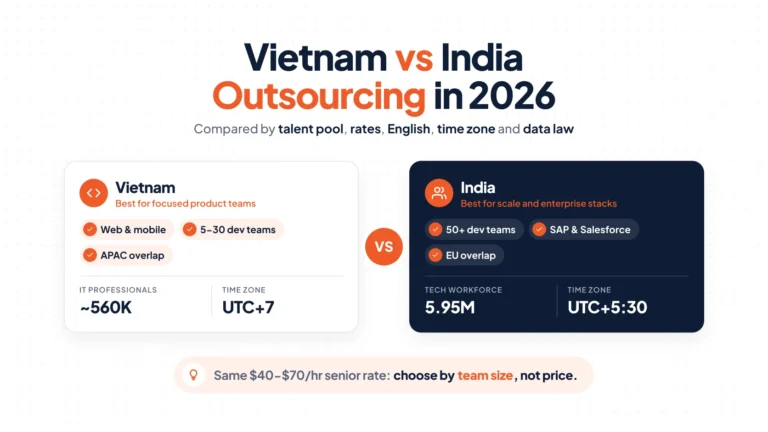
The rate gap explains it. A senior full-stack engineer costs $30-$50 per hour in Vietnam versus $120-$200 in North America (InApps). The common setup: product owner and tech lead in your time zone, engineers offshore with 2-4 hours of daily overlap. Details: IT staff augmentation cost guide and offshore vs nearshore.
7. Security and AI Compliance Become Vendor Selection Criteria
Security checks and AI rules now filter vendors before price does. The EU AI Act treats AI used in recruitment and employment as high-risk. The Digital Omnibus moved those duties from Aug 2, 2026 to Dec 2, 2027 (Gibson Dunn). Vendors that screen candidates with AI for EU roles must prepare now.
For any engineer with repository access, require ISO/IEC 27001 or SOC 2, an NDA, IP assignment from the first commit, and a written AI tool data policy. Full list: risks of IT staff augmentation.
8. Skills-Based Matching Replaces Job-Title Hiring
Buyers now request verified skills and outcomes, not job titles. “Senior developer” is too vague. “Move 40 services to Kubernetes” or “ship RAG search on our docs” lets a vendor match the right engineer and test for it.
Good vendors verify skills with a technical interview or a paid trial task, then start engineers in 1-2 weeks (InApps). Write a one-page skills brief first: stack, seniority, outcome, time-zone overlap and start date.
Which IT Roles Are Most in Demand for Staff Augmentation in 2026?
AI/ML, data, cloud, cybersecurity and senior full-stack roles lead staff augmentation demand in 2026. SIA links IT staffing demand to data, cloud, cybersecurity, application development, integration and AI transformation projects (SIA).
| Role | Why demand is rising | Hiring tip |
|---|---|---|
| AI/ML engineer, LLM developer | AI skills are the #1 global shortage (ManpowerGroup 2026) | Ask for shipped production AI, not only notebooks |
| Data engineer | AI projects stall without clean data pipelines | Test SQL, orchestration and data quality checks |
| Cloud / DevOps / platform engineer | IaaS spending grows about 29% in 2026 (Gartner, July 2026) | Check certifications for your cloud |
| Cybersecurity engineer | Compliance and AI risk raise the security bar | Verify hands-on incident and audit work |
| Senior full-stack / tech lead | Senior AI-focused postings up ~15% (Indeed) | Assess code review and architecture skills |
How Should You Adjust Your Staff Augmentation Plan for 2026?
Use staff augmentation when you need new skills fast and will manage the work yourself. Use this table to pick the model:
| Your situation | Best model |
|---|---|
| No new skills needed within 30 days | Hire full-time or upskill your team |
| New skills needed fast, your team manages the daily work | IT staff augmentation (senior + AI-fluent, T&M + KPIs) |
| New skills needed fast, vendor manages, scope is fixed | Project outsourcing |
| New skills needed fast, vendor manages, scope keeps changing | Dedicated team or managed services |
2026 buyer checklist:
- Screen every candidate for AI tool fluency and code review skills.
- Keep one senior reviewer per 3-4 augmented engineers.
- Add replacement, ramp-up, quality and retention KPIs to the contract.
- Confirm ISO/IEC 27001 or SOC 2, IP assignment and an AI tool data policy.
- Plan 2-4 hours of daily time-zone overlap for offshore engineers.
Need senior, AI-fluent engineers in 1-2 weeks? See InApps engineer profiles and rates or talk to us. Comparing vendors? Start with top IT staff augmentation companies in Vietnam.
FAQ: IT Staff Augmentation Trends
What are the latest IT staff augmentation trends?
The main trends in 2026 are AI skill shortages, demand for senior AI-fluent engineers, talent access over cost, outcome KPIs in contracts, hybrid human and AI agent teams, blended offshore teams, stricter compliance vetting and skills-based matching.
Is IT staff augmentation still growing in 2026?
Yes, slowly. SIA forecasts US IT staffing revenue of $37.7B in 2026, up 1% and the first growth since 2022. Spending on AI-related IT work grows much faster.
How is AI changing IT staff augmentation?
AI changes both what companies hire and how. AI skills are the hardest to find, so companies augment them. AI coding tools reduce demand for junior coders and raise demand for seniors who review AI output.
Will AI replace IT staff augmentation?
No. AI shrinks team size, but someone still has to direct AI agents, review code and own production systems. Staffing firms are now placing hybrid human and AI agent teams instead.
How big is the IT staff augmentation market?
It depends on the definition. Global estimates for 2026 range from $1.09B to $434.1B. The US IT staffing market, a more reliable measure, is about $37.7B in 2026.
Which IT skills are most in demand for staff augmentation?
AI/ML engineering, data engineering, cloud and DevOps, cybersecurity and senior full-stack development are the most requested skills in 2026.
Work with us
Need a team that can do this on your codebase?
Tell us what you are shipping and we will send back a scope, a team shape and a fee. No obligation.
Book a free call