On this page
On this page
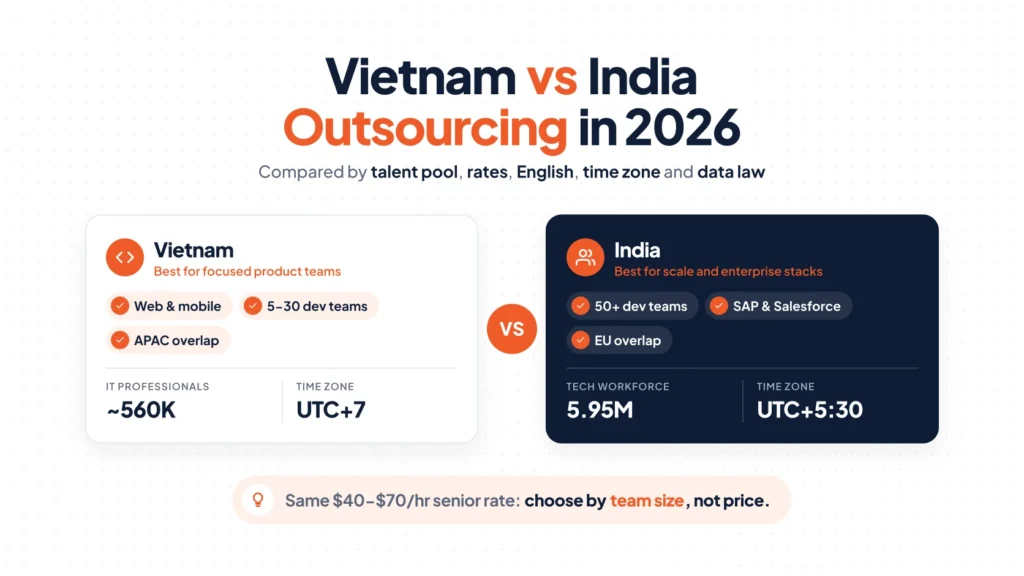
Quick answer: In Vietnam vs India outsourcing, choose India for scale and Vietnam for focused product teams. India has a tech workforce of about 5.95 million and more than 2,100 global capability centers. Vietnam has about 560,000 IT professionals, roughly a tenth of that. Vendor rates overlap at every level: senior developers cost about $40-$70 per hour in both (Nasscom via ETV Bharat; TopDev via Second Talent; Saigon Technology, 2026). Decide by team size and stack, not by price.
InApps is a software company based in Vietnam. Every number below comes from third-party sources, linked inline, and India wins the rows where the data says it should.
Vietnam vs India Outsourcing at a Glance
India and Vietnam charge similar rates, so the real choice is between India’s depth and Vietnam’s fit for smaller, stable product teams. This India vs Vietnam outsourcing table shows where each country leads.
| Factor | India | Vietnam | Edge |
|---|---|---|---|
| Tech workforce | ~5.95 million (FY26) | ~560,000 IT professionals | India |
| GitHub developers (2025) | 21.9 million | Not in GitHub’s top 10 | India |
| Senior dev billing rate | $40-$70/hr | $40-$70/hr | Tie |
| Junior dev billing rate | $15-$25/hr | $18-$30/hr | India |
| English (EF EPI 2025) | 484, Low (74th) | 500, Moderate (64th) | Close (see below) |
| Time zone | UTC+5:30 | UTC+7 | India for EU, Vietnam for APAC |
| Captive centers (GCCs) | 2,117 companies, 3,728 centers | Small, growing | India |
| Kearney GSLI 2023 | 1st | Rank not published | India |
| Main client markets | US, UK, EU | Japan, Korea, US, EU | Depends on you |
| Data protection law | DPDP Act 2023, full rules from May 2027 | PDPL, Law 91/2025 (from Jan 2026) | Tie (both new) |
| Fixed broadband (Ookla) | 98th (Aug 2025) | 7th (Jul 2026) | Vietnam |
| IP protection (USTR 2026) | Priority Watch List | Priority Foreign Country | India |
Sources: workforce from Nasscom Strategic Review 2026 via ETV Bharat and TopDev via Second Talent; GitHub counts from The Register on Octoverse 2025; rates from Saigon Technology (2026); English from the EF EPI 2025 India fact sheet and Vietnam fact sheet; GCCs from Zinnov-Nasscom via Communications Today; GSLI from Kearney 2023 summary; broadband from Ookla via VTC News and TelecomTalk; IP from the USTR 2026 Special 301 report via Outlook Business.
For how both countries rank against Poland, the Philippines and Latin America, see our ranking of the best countries to outsource software development.
Is Vietnam Cheaper Than India for Software Development?
No, not in a way that should decide your choice: senior developers bill about $40-$70 per hour in both countries, and India is slightly cheaper at the junior level. Claims that Vietnam is “30-50% cheaper” come from vendor blogs and rarely cite data.
| Seniority | India (per hour) | Vietnam (per hour) |
|---|---|---|
| Junior | $15-$25 | $18-$30 |
| Mid-level | $25-$40 | $22-$46 |
| Senior | $40-$70 | $40-$70 |
Source: Saigon Technology (2026). India rates are industry estimates; Vietnam rates are that vendor’s own card. Accelerance, which tracks rates worldwide, called 2026 rates “stable” and named talent and delivery quality as the new price drivers (Accelerance).
Vendors often argue that lower turnover makes Vietnam cheaper over time. Test that with numbers:
A $3 hourly difference costs about 14 times more than six points of attrition: $54,000 vs $3,840 a year. Turnover hurts most when you lose a tech lead or architect, because the lost system knowledge is not in this formula. So compare rates for the bulk of the team, and ask for retention clauses on key roles. Rates by role are in our IT staff augmentation cost guide.
Calculator
Attrition cost vs rate gap: run your own numbers
Enter your team and the two vendor quotes. Results update as you type.
Your team
The two vendors
Your results
The rate gap costs 14.1x more than the attrition gap. Compare rates for most of the team, and add retention clauses for key roles.
Assumes 40 hours per week and 1,800 billable hours per year.
Vietnam vs India Software Development: How Big Is the Talent Gap?
India’s software talent pool is about 10 times larger than Vietnam’s: 5.95 million tech workers vs about 560,000 IT professionals. That gap decides large and specialist projects. It matters much less for a team of 5-20 engineers.
India is the world’s largest IT services exporter. Nasscom puts FY26 industry revenue at $315 billion, with $246 billion from exports (ETV Bharat). GitHub counted 21.9 million developers in India in 2025, and India added more new developers than any other country (The Register). Global companies run 3,728 capability centers there, employing 2.36 million people (Zinnov-Nasscom via Communications Today). Strong fits: teams of 50+, fast ramp-ups, SAP, Salesforce, ServiceNow, mainframe and other enterprise stacks, and captive centers you plan to own.
Vietnam built its industry on engineering exports to Japan and Korea. It is Japan’s second-largest software outsourcing partner, with about 6-7% of a $30 billion+ market (VOV; Vietnam MIC). Japanese clients demand detailed specs and strict QA, and that discipline carries over to Western projects. Strong fits: web and mobile apps, backend and cloud work, QA automation, and data engineering in teams of 5-30.
Decision rule: if you need more than about 50 engineers within six months, or a niche enterprise platform, start in India. Below that, both countries can staff you, and vendor quality matters more than country.
Where Does Vietnam Have a Real Edge Over India?
Vietnam’s verifiable edges over India are faster fixed internet, a growing base of big-tech R&D centers, solid school-level math and new tax incentives for tech firms since January 2026. None of them offsets India’s 10 times larger talent pool. Each row shows the evidence and the catch.
| Vietnam edge | Evidence | The catch |
|---|---|---|
| Fixed broadband for remote and hybrid teams | 7th in the world in July 2026, vs India 98th in August 2025 (Ookla) | Different months; office lines in Indian tech hubs are reliable, and India ranks 25th on mobile speed |
| Big-tech R&D centers | Samsung’s $220 million Hanoi R&D center (opened December 2022), Qualcomm’s AI R&D center in Hanoi (June 2025), an Nvidia R&D center agreement (December 2024) | India hosts 3,728 global capability centers; Vietnam’s list is far shorter |
| STEM foundation | PISA 2022: 72% of Vietnamese 15-year-olds reach baseline math, vs 69% OECD average | India does not take part in PISA, so there is no direct comparison; only 5% of Vietnamese students are top performers, vs 9% OECD |
| Policy tailwind | Law on Digital Technology Industry in force since January 1, 2026: tax incentives for tech firms, 5-year visas for foreign experts; a plan to train 50,000 semiconductor graduates by 2030 | Incentives lower vendor costs; buyers benefit only if vendors pass the saving on |
Sources: Ookla via VTC News and TelecomTalk; Samsung via The Star; Qualcomm via The Star; Nvidia via The Star; OECD PISA 2022 Viet Nam note; India’s PISA opt-out from The Wire; the digital technology law from Vietnam Briefing; the semiconductor plan from Decision 1017/QD-TTg.
These edges matter most for a distributed product team of 5-30 engineers. For a 200-person delivery center, India’s depth still wins.
Which Country Has Better English: India or Vietnam?
On the EF English Proficiency Index 2025, Vietnam scores slightly higher than India (500 vs 484), but Indian IT teams usually have more practice in client-facing English. The index alone gives the wrong picture here.
EF tests self-selected adults, not IT workers, and India’s score of 484 places it in the Low band at 74th, below the global average of 488 (EF India fact sheet). Vietnam scored 500, Moderate band, 64th (EF Vietnam fact sheet). Inside the IT sector, the picture flips: Indian engineers study in English and have decades of US and UK client calls behind them. Vietnamese engineers usually write strong technical English but speak less fluently.
What this means in practice:
- Daily calls with business stakeholders: India has the edge.
- Spec-driven work (tickets, pull requests, written updates): both work well.
- Vietnam teams: require a B2+ English project manager or tech lead as the main contact.
Whichever country you pick, test spoken English in the interview. Ask each candidate to explain a past technical decision in five minutes.
Time Zone Overlap for US, European and APAC Teams
India (UTC+5:30) sits 1.5 hours closer to Europe and the US than Vietnam (UTC+7), while Vietnam sits closer to Australia, Japan and Korea. Your own location decides which gap helps you.
| Your location | India gap | Vietnam gap | Overlap in a 9-to-6 day |
|---|---|---|---|
| New York (ET) | +9.5 to +10.5 h | +11 to +12 h | Both need a shifted window; India needs 1.5 h less shift |
| London (UK) | +4.5 to +5.5 h | +6 to +7 h | India about 4-5 h, Vietnam about 2-3 h |
| Berlin (CET) | +3.5 to +4.5 h | +5 to +6 h | India about 5 h, Vietnam about 3 h |
| Sydney (AET) | -4.5 to -5.5 h | -3 to -4 h | Vietnam about 4-5 h, India about 3 h |
| Tokyo / Seoul | -3.5 h | -2 h | Vietnam about 7 h, India about 5 h |
Ranges cover daylight saving. For US buyers, neither country gives a shared working day, so both rely on a 1-2 hour overlap and written handovers. If you need a same-day US schedule, our nearshore vs offshore guide covers Latin America.
Attrition, Data Protection and Delivery Risk
India’s largest IT firms report 12.8-15.1% attrition, and Vietnam has no reliable public attrition figure, so ask every vendor for its own trailing 12-month rate. Both countries also brought in new data protection laws in 2026-2027.
TCS reported 13.8% attrition in Q1 FY26, Infosys 14.4%, HCL Tech 12.8% and Wipro 15.1% (Angel One). Smaller Indian vendors often run higher. For Vietnam, published estimates range from 10% to 30% and come from recruiters and vendors, not official statistics. Treat any “Vietnam has much lower attrition” claim as unproven until the vendor shows its own data.
| Risk area | India | Vietnam |
|---|---|---|
| Main law | Digital Personal Data Protection Act 2023 + DPDP Rules 2025 | PDPL, Law No. 91/2025/QH15 |
| In force | Rules notified Nov 13, 2025; core duties apply from May 13, 2027 | January 1, 2026 |
| Regulator | Data Protection Board of India | Ministry of Public Security |
| Cross-border transfer | Allowed unless the government restricts a country | Transfer impact assessment filed within 60 days |
| Maximum penalty | Up to INR 250 crore per breach | Up to 5% of prior-year revenue (cross-border breaches) |
| IP protection (USTR Special 301, 2026) | Priority Watch List | Priority Foreign Country, the most severe category |
Sources: India DPDP timeline from Storyboard18 and Hogan Lovells; Vietnam PDPL from Allen & Gledhill and Tilleke & Gibbins; IP status from the USTR 2026 Special 301 report via Outlook Business.
IP is Vietnam’s weakest row. In April 2026 the USTR named Vietnam a Priority Foreign Country, the first country in that category in 13 years, citing a lack of progress on IP protection; India stays on the Priority Watch List. The designation concerns national IP policy and enforcement, not individual software vendors, but it raises the value of strong contracts.
In both countries, keep code and production data in cloud accounts you own, sign IP assignment clauses under your own governing law, ask for ISO 27001 or SOC 2 evidence, and add your own GDPR or HIPAA clauses on top of local law.
Vietnam or India: Which Should You Choose?
Choose India when you need scale, speed of hiring or a niche enterprise stack, and Vietnam when you need a stable product team of 5-30 engineers or APAC overlap. The matrix maps common needs to the stronger country.
| What you need | Better choice | Why |
|---|---|---|
| 50+ engineers within 6 months | India | 10x larger pool, faster ramp-up |
| SAP, Salesforce, ServiceNow, mainframe | India | Deepest certified bench worldwide |
| Your own captive center (GCC) | India | 2,117 companies already run one there |
| Daily overlap with UK or EU teams | India | 2 more shared hours than Vietnam |
| Daily calls with business stakeholders | India | More practice in client-facing English |
| Web or mobile product team (5-30 devs) | Vietnam | Engineering-first vendors, similar rates |
| Clients or offices in Japan, Korea, Australia | Vietnam | Closer time zone, Japan project experience |
| Mostly remote or hybrid engineers | Vietnam | Fixed broadband ranks 7th vs India 98th (Ookla) |
| Second delivery site next to an existing India team | Vietnam | Spreads country risk; only 1.5 h apart for handovers |
| QA automation, data engineering | Either | Compare vendors, not countries |
A quick way to decide:
Do you need 50+ engineers or a niche enterprise platform?
Is your team mainly in UK or EU and needs 4+ shared hours?
Is it a product team of 5-30 engineers, or are you in APAC?
Already leaning toward Southeast Asia? Our Vietnam vs Philippines outsourcing comparison covers the other common shortlist. Picked Vietnam? Compare vetted Vietnam vendors, or test a small dedicated development team before you scale.
FAQ: Vietnam vs India Outsourcing
Is Vietnam or India better for software outsourcing?
India is better for large teams and niche enterprise stacks, with about 5.95 million tech workers. Vietnam is better for focused product teams of 5-30 engineers and for buyers in Japan, Korea or Australia. Senior rates are similar in both, at about $40-$70 per hour.
Is Vietnam cheaper than India?
Not meaningfully. Senior developers bill about $40-$70 per hour in both countries, and India is slightly cheaper at the junior level ($15-$25 vs $18-$30). Compare total cost, including rework, management time and the vendor’s actual attrition.
Does India or Vietnam have more software developers?
India, by about 10 times. Nasscom counts 5.95 million tech workers in India, and GitHub counted 21.9 million Indian developers in 2025. Vietnam has about 560,000 IT professionals.
Which has better English, India or Vietnam?
Vietnam scores slightly higher on the EF English Proficiency Index 2025 (500 vs 484). In practice, Indian IT teams usually speak more fluently with clients, because they study in English and have long experience with US and UK projects. Vietnamese engineers write strong technical English.
Is attrition lower in Vietnam than in India?
It is not proven. India’s top IT firms reported 12.8-15.1% attrition in Q1 FY26. Vietnam has no official figure, and published estimates range from 10% to 30%. Ask each vendor for its trailing 12-month attrition rate.
Is Vietnam a good alternative to India for outsourcing?
Yes, for mid-size product and engineering teams. Vietnam offers similar rates, a strong STEM pipeline and closer time zones for APAC buyers. It is not a full replacement for India when you need hundreds of engineers or rare enterprise skills.
What are Vietnam’s advantages over India for software outsourcing?
Vietnam ranks 7th in the world for fixed broadband (India 98th), hosts growing R&D centers from Samsung, Qualcomm and Nvidia, beats the OECD average on baseline school math, and has offered new tax incentives for tech firms since January 2026. The trade-offs are a talent pool about 10 times smaller and weaker IP protection: the USTR named Vietnam a Priority Foreign Country in 2026.
Next step: still comparing? Talk to us. We will tell you honestly whether your project fits a Vietnam team or would be better served in India, and compare rates and overlap hours in one call.
Work with us
Need a team that can do this on your codebase?
Tell us what you are shipping and we will send back a scope, a team shape and a fee. No obligation.
Book a free call