On this page
On this page
Quick answer: To hire AI engineers, define the outcome first, pick the exact role (LLM application, machine learning, MLOps or data engineer), choose a hiring model, then test candidates on a paid, job-like task with an evaluation set. Budget by market: machine learning engineers average about £75,000 in the UK, €70,000 in Germany, A$135,000 in Australia and US$184,000 in the US (Indeed, Oct 2026), while senior offshore developers bill roughly $31-$76 per hour by region (Accelerance). Lock down data access and IP terms before day one.
Key takeaways:
- “AI engineer” covers four different jobs. Hire for the deliverable, not the title.
- Full-time hiring, at home or abroad through an Employer of Record, suits long-term ownership. Staff augmentation suits a defined gap and can start in 1-2 weeks.
- Test production judgement: evaluation, failure handling and cost trade-offs. Framework lists prove little.
- Put data access, IP assignment and evaluation assets in the contract before the engineer starts.
What Does an AI Engineer Do?
An AI engineer builds production software on top of machine learning models or large language models (LLMs): retrieval pipelines, agents, model integrations, evaluation suites and monitoring. The role sits between software engineering and data science, and it ships features rather than research papers.
Demand is global. The World Economic Forum ranks AI and machine learning specialists among the three fastest-growing jobs worldwide through 2030 (WEF Future of Jobs Report 2025). LinkedIn’s 2026 Jobs on the Rise lists put AI engineer at number one in both the US (Social Media Today) and Australia (HR Leader).
Strong candidates have options in every market. A clear brief, a fast process and a fair assessment win them more often than salary alone.
Step 1: Define the Outcome and the Exact AI Role
Start every AI engineer hire with one written outcome, then map it to the role that delivers it. An LLM application engineer, a machine learning engineer, an MLOps engineer and a data engineer solve different problems, and each needs a different screen.
| Role | What they build | Hire this role when | Screen for |
|---|---|---|---|
| LLM application engineer | RAG pipelines, agents, prompt and tool logic, app-level evaluation | You are adding AI features on top of existing models (OpenAI, Anthropic, Gemini) | Evaluation design, failure handling, tool permissions, cost per request |
| Machine learning engineer | Trained or fine-tuned models, feature pipelines | Off-the-shelf models do not fit your data or accuracy target | Baselines, data splits, leakage checks, model selection |
| MLOps engineer | Deployment, monitoring, retraining and rollback | Models already work but break or drift in production | Reproducible releases, observability, incident response |
| Data engineer | Ingestion, transformation, data quality | Your data is scattered, unclean or inaccessible | Lineage, access control, pipeline recovery |
Write the brief around one deliverable. “Ship a support assistant that answers from approved documents and passes an agreed evaluation set” beats “build our AI capability”. List secondary duties separately and name who owns them.
Decision rule: if you only integrate existing models, hire an LLM application engineer first. If your data is not ready, hire a data engineer before anyone else.
Step 2: Choose a Hiring Model
Pick the hiring model by asking who will own the AI system after the first release. Hire full-time when the role carries long-term product accountability. Use staff augmentation or a dedicated team when you need a defined skill gap closed fast and your own lead can review the work.
| Model | Time to first engineer | Cost basis | Who manages daily work | Best when |
|---|---|---|---|---|
| Full-time hire | Months (sourcing, interviews, notice periods) | Salary + benefits + recruiting | You | AI is a core, long-term product function |
| Employer of Record (EOR) | Weeks, plus the candidate’s notice period | Local salary + monthly EOR fee | You | A full-time hire in a country where you have no legal entity |
| Freelancer / contractor | Days to weeks | Hourly or fixed fee | You | A small, isolated task with low data sensitivity |
| Staff augmentation | 1-2 weeks (InApps) | Monthly, on hours worked | You | 1-2 engineers for a defined gap, with an internal reviewer |
| Dedicated team | 4-6 weeks to a full team | Monthly team fee | The team’s tech lead | A multi-person AI roadmap without spare managers |
Will this person set the AI roadmap for 2+ years?
Do you have an internal lead to review their work?
Is it a one-off task with no sensitive data?
Many teams combine models: an augmented engineer builds the first evaluation suite and pipeline, then a permanent hire takes ownership. For a full comparison, see staff augmentation vs dedicated team vs ODC. For how the augmentation model works with AI roles specifically, read the AI staff augmentation guide.
Step 3: Where to Find AI Engineers
The best AI engineer candidates show their work in public or come through people who have seen it. Job boards alone return many applicants who list AI frameworks without having shipped an AI system.
Use these channels, in rough order of signal quality:
- Referrals from your engineers. They can vouch for shipped work and working style.
- Open-source footprints. Check GitHub, Hugging Face and Kaggle for maintained projects, evaluation code and clear READMEs.
- AI communities and meetups. LangChain, LlamaIndex and local ML groups surface practitioners who build in public.
- Specialist recruiters. Useful for senior full-time roles. Confirm they screen technically, not by keyword.
- Staff augmentation partners. They supply pre-vetted engineers you still interview and approve. Ask for their vetting stages and pass rate.
If your local market is thin or expensive, widen the search to other regions and compare their costs in Step 6. Remote AI work only needs a few hours of daily overlap with your reviewer.
Whatever the channel, ask each candidate for one system they shipped, what it did and how they knew it worked. That single question filters out most title inflation.
Step 4: Which Skills Should an AI Engineer Have?
A hireable AI engineer combines solid software engineering with AI-specific judgement: they can build the system, measure whether it works and keep it working in production. Weight the last two higher than familiarity with any single framework.
| Skill area | Must-have signals | Nice to have |
|---|---|---|
| Software engineering | Python, APIs, testing, Git, code review habits | TypeScript or Go for product integration |
| AI and LLM | LLM APIs, RAG, embeddings, vector databases (Pinecone, Weaviate) | Fine-tuning, agent frameworks (LangGraph, CrewAI) |
| Evaluation | Builds test sets, defines pass criteria, tracks regressions | Automated LLM-as-judge pipelines with human spot checks |
| Production | Logging, monitoring, cost and latency tracking, rollback | Kubernetes, MLOps platforms |
| Data | Data cleaning, access controls, privacy awareness | Data pipeline tooling |
| Communication | Explains trade-offs to non-technical stakeholders | Writes clear design docs |
Red flags in an AI engineer interview:
- Lists ten frameworks but cannot describe how they measured output quality.
- Shows a polished demo but has no failure cases or held-out tests.
- Treats inference cost and latency as someone else’s problem.
Step 5: Run an Interview Process That Tests Production Work
Assess AI engineers with job-like evidence: a short paid exercise, a production-failure discussion and a cost trade-off question, scored against a written rubric. Interview the named engineer who will write the code, not a vendor’s tech lead.
| Stage | Format | Time | What it proves |
|---|---|---|---|
| 1. Screening call | Walk through one shipped AI system | 30 min | Real ownership vs title inflation |
| 2. Paid take-home | Improve a small RAG or model task, with an evaluation set | 3-4 hours | Builds, measures and documents trade-offs |
| 3. Failure interview | A sanitised account of a post-release incident | 45 min | Debugging, recovery and prevention habits |
| 4. Team interview | Review the take-home with your engineering lead | 60 min | Fit with your codebase and review culture |
Design the take-home well. Give synthetic or approved sample data, a working baseline and a few tricky cases, such as an outdated document or a question the data cannot answer. Ask for runnable code, an evaluation set with failure cases and a short note on cost and limits. Keep some test cases hidden until the review.
Agree the AI coding assistant policy up front. If assistants are allowed, require disclosure and ask the candidate to modify part of their solution live. You are hiring for ownership of the result.
AI Engineer Interview Questions That Reveal Real Experience
These AI engineer interview questions separate production experience from tutorial experience. Each one has a clear “strong answer” signal.
| Question | A strong answer includes |
|---|---|
| How did you know your last AI feature was good enough to ship? | A named evaluation set, pass threshold and known failure cases |
| Tell me about an AI system that misbehaved after release. | Symptom, how they narrowed the cause, the fix and the alert added afterwards |
| Traffic doubles but the inference budget stays flat. What do you measure first? | Cost per request by journey, cache hit rate, model routing options |
| Users say answers are slow. Where do you look? | Splits retrieval time from generation time before proposing fixes |
| When would you fine-tune instead of using RAG? | Ties the choice to data freshness, volume, cost and evaluation results |
| What data would you refuse to send to a third-party model? | Names PII, secrets and contract limits, and proposes masking or approved services |
Step 6: How Much Does It Cost to Hire an AI Engineer?
The cost to hire an AI engineer depends mostly on where the engineer is based: average machine learning engineer salaries run from about ₹11 lakh a year in India to US$184,000 in the US, and senior offshore developers bill $31-$76 per hour by region. Compare options over the same period, in one currency, and include your own management time on each side.
In-house salary benchmarks (machine learning engineer, average base salary):
| Market | Average base salary | Salaries reported |
|---|---|---|
| United States | US$184,094 / year | 5,400 |
| Canada | C$139,855 / year | 324 |
| Australia | A$135,099 / year | 110 |
| Singapore | S$8,668 / month | 218 |
| United Kingdom | £74,964 / year | 1,200 |
| Germany | €70,383 / year | 48 |
| India | ₹11,21,882 / year | 50 |
Outsourced and augmented rates (senior engineer, per hour):
| Region | Senior rate | Source |
|---|---|---|
| North America (full-stack contractor) | $120-$200 | InApps market benchmark |
| Nearshore Europe | $64-$76 | Accelerance 2026 guide |
| Latin America | $60-$75 | Accelerance 2026 guide |
| South Asia | $31-$41 | Accelerance 2026 guide |
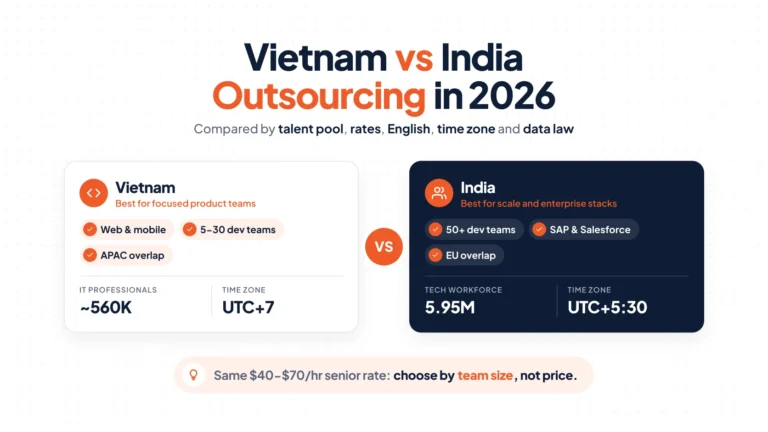
| Vietnam / SE Asia (AI/ML engineer) | $40-$65 | InApps market benchmark |
Use two simple formulas:
Full-time annual cost
= base salary × (1 + benefits & payroll overhead %) + recruiting cost + your management time
Augmentation annual cost
= hourly rate × billable hours (≈160/month × 12) + your management time
Scenario (US dollars, assumptions stated): an in-house engineer on a $140,000 base with an assumed 30% employer overhead costs about $182,000 a year before recruiting fees. An augmented AI/ML engineer at $55/hour for 1,920 hours costs about $105,600. Swap in your local salary, overhead and currency, and add review time to both sides.
Scenario (US dollars, assumptions stated)
- $140,000 base
- 30% employer overhead
- $55/hour for 1,920 hours
Add review time to both sides.
Keep inference and infrastructure costs separate, so a cheaper model does not look like a cheaper engineer. Those costs move fast: inference for GPT-3.5-level performance fell more than 280-fold between November 2022 and October 2024 (Stanford AI Index 2025). For rate details by role, see the IT staff augmentation cost guide.
Step 7: Agree Data Access, IP and the First 30 Days
Settle data access, IP ownership and evaluation ownership in writing before an AI engineer touches your systems. These terms protect you whether the engineer is an employee, a contractor or augmented staff, and wherever they are based.
Put these five items in the contract or offer:
- Data-access map: which sources are available in development, who approves production access, how access is revoked and which data may leave its region under privacy laws such as the EU GDPR.
- Approved AI tools: which model APIs and coding assistants may receive your code, prompts or data.
- IP assignment: employers usually own what employees create in the course of their job, but contractors can keep copyright unless a written assignment exists. See the UK Copyright, Designs and Patents Act 1988, s.11 and the US Copyright Office Circular 30 for two examples. Have counsel check the wording for every jurisdiction involved.
- Evaluation assets: test cases, labels, scoring scripts and baseline results are deliverables you keep.
- Handover: documentation good enough for a second engineer to run the evaluation suite alone.
Then plan the first month around a small, reviewable win:
| Window | Engineer’s goal | Evidence before moving on |
|---|---|---|
| Days 1-3 | Access, architecture walkthrough, read existing evaluations | Working dev environment, named reviewer |
| Days 4-10 | Ship one small change, such as an evaluation for an existing feature | First pull request merged |
| Days 11-30 | Improve one measured behaviour | Before/after evaluation results, known limits documented |
For teams in different time zones, agree overlap hours and a reviewer who can respond during the engineer’s day. Once the feature heads to production, use the LLM production deployment guide as the release checklist.
Common Mistakes When Hiring AI Engineers
Most failed AI engineer hires trace back to a vague role, a CV-based screen or a missing internal owner, not to a lack of talent. Check your process against these mistakes before you sign.
| Mistake | Fix |
|---|---|
| One hire expected to own models, data, apps and operations | Pick the primary deliverable and assign the rest |
| Screening by framework names on a CV | Score a bounded exercise with an evaluation set |
| Interviewing a vendor’s lead instead of the actual engineer | Interview the named engineer who will join |
| Treating a good demo as production readiness | Add hidden test cases, failure and recovery questions |
| Comparing a salary with an hourly rate | Compare annual totals, including your management time |
| Granting production access to speed up onboarding | Approve permissions explicitly, start on synthetic data |
| Leaving evaluation assets with the supplier | Make them contract deliverables |
How InApps Helps You Hire AI Engineers
InApps provides dedicated AI/ML engineers through staff augmentation: you interview and approve every engineer, and they join your sprints and report to your engineering lead. Each engineer works only on your product and talks to your team directly, with no project manager in between.
- Vetting: only 3% of applicants pass InApps’ four-stage process (live coding and system design, English communication, agile collaboration, final panel with reference checks).
- Speed: first CVs within 72 hours of signing an NDA, and the first engineer typically in place in 1-2 weeks.
- AI stack: LangChain, LlamaIndex, Pinecone, Weaviate, n8n and Dify, at mid, senior or lead level.
- Ownership: code and IP are assigned to you from the first commit, with no payment gate.
- Time zones: engineers in Vietnam (UTC+7) overlap 3-5 hours with Australian business hours and cover European mornings and early US mornings.
- Flexibility: scale up or down on two weeks’ notice, with a 30-day replacement guarantee.
Recommended path for teams with an AI lead but no spare engineers: InApps AI staff augmentation
- Why it fits: you keep technical ownership, and a vetted AI/ML engineer closes the delivery gap in 1-2 weeks instead of a multi-month search.
- Pricing: AI/ML engineers in Vietnam benchmark at $40-$65/hour.
- Trade-off: you still need an internal lead to review pull requests and own the roadmap. Without one, a dedicated team is the better fit.
- Action: Book a call to scope your AI role
Building an AI product rather than hiring for one? See AI agent development.
FAQ: Hiring AI Engineers
How much does it cost to hire an AI engineer?
It depends on the market. Machine learning engineers average about £75,000 in the UK, €70,000 in Germany, A$135,000 in Australia and US$184,000 in the US in base salary (Indeed, October 2026), before benefits and recruiting. Senior offshore developers bill roughly $31-$76 per hour by region, and AI/ML engineers in Vietnam $40-$65.
How long does it take to hire an AI engineer?
A full-time AI engineer search usually takes months once you count sourcing, several interview rounds and the candidate’s notice period. Staff augmentation is faster: InApps sends first CVs within 72 hours of an NDA and typically places the first engineer in 1-2 weeks.
Where can I find AI engineers to hire?
Start with referrals from your engineers, then open-source footprints on GitHub, Hugging Face and Kaggle, AI community meetups and specialist recruiters. For speed, use a staff augmentation partner that pre-vets engineers and lets you interview the named candidate before any commitment.
What is the difference between an AI engineer and a machine learning engineer?
An AI engineer, in current usage, builds applications on top of existing models, such as LLM features, RAG pipelines and agents. A machine learning engineer trains, fine-tunes and evaluates models themselves. Hire an ML engineer only when off-the-shelf models cannot meet your data or accuracy needs.
What skills should I look for when hiring an AI engineer?
Look for strong Python and software engineering, hands-on LLM and RAG work, vector databases, evaluation design and production habits such as monitoring, cost tracking and rollback. Clear communication matters too. Weight evaluation and production evidence above framework familiarity.
How do I test an AI engineer’s skills?
Use a paid 3-4 hour take-home that improves a small RAG or model task against an evaluation set, with hidden test cases. Follow it with a production-failure interview and a cost or latency trade-off question, all scored against a written rubric.
Can I hire AI engineers from another country?
Yes. Use an Employer of Record to hire full-time where you have no legal entity, or staff augmentation to add vetted engineers under a service contract. Either way, contract data access, approved AI tools, IP assignment and evaluation assets, check data-transfer rules such as GDPR, and start the engineer on synthetic data.
Work with us
Need a team that can do this on your codebase?
Tell us what you are shipping and we will send back a scope, a team shape and a fee. No obligation.
Book a free call